
IMAGE: bird story agency
As Dakar 2026 prepares to make history as Africa’s first Youth Olympic Games, six young refugees are building a path from community sport to elite international competition. Their journey highlights the promise of sporting inclusion.
By Bonface Orucho, bird story agency
30 October 2026
At 16, Clement Niyomuhoza is preparing to race the 800 metres at the Dakar 2026 Youth Olympic Games. The young runner has set himself a simple target: gold. But his ambitions extend beyond the track.
Niyomuhoza grew up in Kenya’s Kakuma Refugee Camp after his family fled Burundi. He wants to use any success in athletics to help children facing the kind of insecurity that can make it difficult to pursue their own ambitions.
“I want to build a home for orphans where children can stay safe, where athletes can get nutrition,” he said. “My heart tells me to do that.”
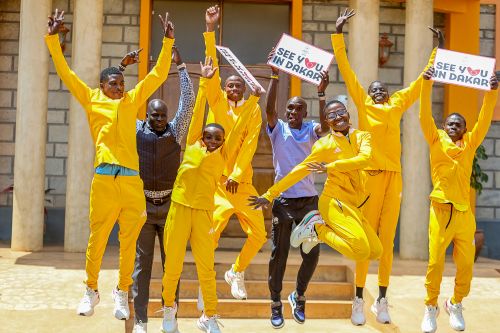
Before he can pursue that ambition, Niyomuhoza has a race to prepare for. In Kaptagat, near Eldoret in Kenya, he has joined five other young athletes affected by displacement at the high-altitude training camp ahead of the Games.
Together, they will compete in athletics, judo and taekwondo as members of the first Refugee Olympic Team to take part in a Youth Olympic Games. The six athletes, three girls and three boys, are normally based across Kenya and Uganda. The camp has brought them together for the first time, giving them an opportunity to train as a team and prepare for the demands of international competition.
Alongside conditioning and sport-specific training, the athletes have taken part in team briefings and media training. They have also met Kenyan Olympic champion Eliud Kipchoge, who mentored them on discipline, goal-setting and teamwork.
For Niyomuhoza, training alongside teammates has been an important part of the experience.
“The training camp has given us a great experience, because we have been able to train together,” he said. “If you practise alone, you don’t get experience, but when you have a partner they can push you, or if you have energy you can push your training partner. And the friendships we have built here are great, we love each other.”
The friendships are part of what the camp has offered, but the gathering also marks a milestone in international sport. The Dakar 2026 Youth Olympic Games will run from 31 October to 13 November in Senegal, bringing together about 2,700 young athletes. Dakar will be the first African host of the Youth Olympic Games and the first edition to feature a Refugee Olympic Team.
For the six athletes, the opportunity is both personal and collective. They will compete in their respective disciplines while representing young refugees whose sporting ambitions can be difficult to pursue when displacement disrupts access to coaching, facilities, nutrition and regular competition.
Niyomuhoza is already thinking about what he might do beyond his own sporting career. For now, his immediate ambition is to win the men’s 800 metres.
“What I’m looking forward to in Dakar is winning a medal – not silver, or even bronze. I want gold,” he said.
His teammates have their own ambitions for what the opportunity could mean.
Lourance Namukiza, 16, will compete in the women’s taekwondo event. She hopes seeing young refugees reach an international competition will encourage others who have given up sport or doubt that they can progress.
“Millions of refugees won’t be at the Olympics, but seeing some of us get there will give them the drive to come back, even those who dropped out of the sport,” she said. “If they can do it, why can’t we?”
Rachid Rochene, 16, will represent the team in the men’s 200 metres. The Uganda-based sprinter described selection as a chance to build on his progress rather than an endpoint.
“Being on the first Youth Olympic team, it’s such a great chance for me,” he said. “Many didn’t make it to where we are, so me being here I feel good, I feel so great. And I won’t just stop here; I’ll go forward.”
Florence Masumbe, also 16 and based in Uganda, will compete in the women’s 200 metres. Her participation, like that of her teammates, offers an opportunity to challenge assumptions about what young people affected by displacement can achieve when given access to training and competition.
The team’s composition reflects the role of host countries in helping young refugee athletes reach international competition. According to the International Olympic Committee (IOC), Kenya is the host National Olympic Committee for judo athlete Arno, 15; Niyomuhoza; Namukiza; and 17-year-old 800-metre runner Nyataba. Uganda is the host committee for Masumbe and Rochene.
But identifying talent is only the beginning. Whether Dakar becomes the start of longer sporting careers will depend partly on whether the athletes can continue to access coaching, facilities, nutrition and competition after the Games.
The IOC says two members of the team were identified through Game Connect, an Olympic Refuge Foundation-supported community sports programme in Uganda. Their selection marks the first time athletes identified through the foundation’s community work have progressed directly into its elite Refugee Athlete Support programme, with funding from the IOC’s Olympic Solidarity programme.
The connection offers a route from community sport towards elite competition. It also points to the importance of programmes that make sport accessible to young refugees and members of host communities, helping identify talent that might otherwise remain outside formal sporting structures. The IOC release does not identify which two athletes came through Game Connect.
The scale of displacement across Africa gives these opportunities significance beyond the six athletes. The IOC reports that East and Southern Africa hosts 6.4 million refugees and asylum-seekers, with children under 18 accounting for an estimated 48 per cent. Kenya and Uganda are among the region’s major refugee-hosting countries. In West and Central Africa, where Senegal is hosting the Games, the IOC reports 20.1 million forcibly displaced and stateless people.
These figures do not indicate how many young people want to pursue competitive sport. They do, however, show the scale of the population for whom displacement can disrupt access to education, training and other opportunities.
For refugee-hosting countries, the challenge is not simply to identify promising athletes. It is to create conditions in which young people can develop their abilities while navigating interruptions to education, family life and access to basic necessities.
The Dakar team is supported through a collaboration involving the Olympic Refuge Foundation, World Athletics, the National Olympic Committee of Uganda and Athletics Kenya, with the National Olympic Committee of Kenya hosting the project. Funding from the IOC’s Olympic Solidarity programme has helped support the athletes’ preparation.
The training camp also connects the young athletes with a wider group of refugee competitors. They are training alongside Kenya-based refugee athletes working towards the Los Angeles 2028 Olympic Games, extending the training environment beyond the youth competition.
World Athletics has committed to supporting refugee athletes through competition opportunities, training, media preparation and safeguarding, with a focus on Dakar 2026 and the World Athletics Championships in Beijing in 2027. Its refugee-athlete programme, established in 2016, has developed from the team that competed at the Rio Olympics into a year-round initiative. An under-20 team began as a pilot in 2022 and subsequently expanded from Kenya to Uganda through collaboration with the Olympic Refuge Foundation, the National Olympic Committee of Uganda, Uganda Athletics and UNHCR.
Such structures can help create a pathway from participation in community sport to elite competition. But selection for an international event does not, on its own, guarantee the support required to sustain a sporting career. Continued coaching, regular competition, adequate nutrition and safeguarding will all matter after Dakar.
The athletes have also received guidance from two figures familiar with the challenges and opportunities of competing on an international stage. One is Eliud Kipchoge, whose career has made him one of Kenya’s best-known athletes. The other is Yiech Pur Biel, the team’s chef de mission, whose own journey took him from life as a young refugee to the Olympic Games.
Kipchoge spoke to the group about the habits needed to pursue their goals, stressing discipline, respect and the importance of recognising that sport belongs to everyone.
“The organisers have done an important job of including refugees in the Youth Olympics,” he said. “This is a real inclusion where humanity is concerned. Refugees have been left out for a long time. But they are people, human beings, they are breathing, and they need space. Now they have the best space to compete in sport.”
His practical advice was to set clear goals and work towards them.
“My advice to you all is first, to be disciplined. Being disciplined means knowing what you’re doing and having a goal and working towards your goal,” he said. “Respect yourself first and then respect others. And lastly, remember that this world belongs to all of us.”
For Biel, the team’s participation carries a personal significance. Originally from South Sudan, he spent much of his youth in Kakuma Refugee Camp before competing in the 800 metres as a member of the first Refugee Olympic Team at Rio 2016. He has since become an IOC member and a UNHCR Goodwill Ambassador.
His experience has given him a role in guiding younger refugee athletes as they prepare for international competition. He sees Dakar as an opportunity not only for the six selected athletes but also for young refugees who may see their own ambitions reflected in the team.
“Since then, sport has truly changed my life,” Biel said of his experience at Rio. “Sport has opened doors for me, and it has also allowed me to change the lives of other refugees, to be a role model for them and hopefully leave a legacy of inspiring others.”
The Refugee Olympic Team first competed at Rio 2016, when 10 athletes took part in the Olympic Games. It subsequently appeared at Tokyo 2020 and Paris 2024. Dakar extends the initiative into youth competition, offering young refugee athletes a chance to compete under the same banner.
“These young people have an opportunity to be great ambassadors and represent the millions of young refugees across the world,” Biel said. “I really believe that Dakar will be a life-changing moment for them, but also for refugees watching them worldwide.”
Sporting officials in Kenya and Uganda have also welcomed the team’s selection, describing it as an opportunity to expand access and challenge the tendency to define athletes by their displacement.
Barnaba Korir, first vice-president of the National Olympic Committee of Kenya, said the experience could broaden the athletes’ sense of what was possible beyond their immediate circumstances.
“I cannot even say the kind of the milestones they have achieved. This is something life-changing experience that they are having,” he said. “Their minds will be open now to the world. They will no longer be confined to a refugee area, they can now participate worldwide, and it changes their perception of life.”
Beatrice Ayikoru, secretary-general of the Uganda Olympic Committee, said that at the starting line, an athlete’s ability should matter more than where they come from.
“When you are at the starting line, and I talk about this from an athletic point of view, no one cares where you come from. You’re an athlete,” she said. “It doesn’t matter whether you come from the USA, whether you come from Uganda or a refugee athlete; it’s the same thing. What matters is being an athlete.”
Jackson Tuwei, president of Athletics Kenya, said the selection should lead to further opportunities for refugee athletes.
“We hope that in future we will get more, we will get more, because these are good talents that have been identified,” he said.
The challenge is to make those opportunities last beyond a single competition. World Athletics and Athletics Kenya have been working to create opportunities for refugees to compete locally, including in cross-country events, while strengthening safeguarding.
The IOC and Olympic Refuge Foundation are also supporting refugee athletes in Kenya who hope to qualify for the Los Angeles 2028 Olympic Games through the Refugee Athlete Support programme. Eligibility requires athletes to be recognised as refugees in their host countries, as determined by UNHCR, and to compete at an elite level in their sports.
For Biel, the significance of Dakar lies in giving young refugees a platform to demonstrate their abilities.
“These young people have talent and just need a platform to showcase it,” he said. “This is the right moment for the first-ever Refugee Olympic Team to be given that opportunity, to go and showcase their talent and represent young refugees.”
bird story agency
Leave a Reply