
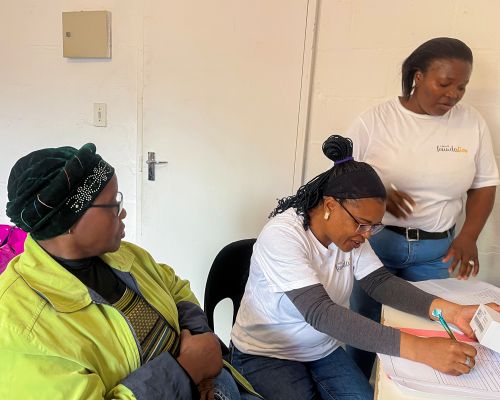
Nomagolide Beja with community health workers at Noah Clinic, Capetown on October 21, 2026. Photo: Someleze Ndede, bird story agency
For millions of Africans, hearing a loved one clearly can depend on a device they cannot afford. 33 million could benefit from hearing aids, yet only one in ten has one, according to the World Health Organization (WHO). In South Africa, where cost and distance keep hearing care out of reach for many families, a local organisation is closing that gap.
By Someleze Ndede, bird story agency
Leaning towards an elderly woman in a dark green headwrap and glasses, a community health worker holds a smartphone where she can see it. She explains the examination, then gently brings a small, illuminated probe to the woman’s ear. An image of the ear canal appears on the screen.
At Noah Clinic in Khayelitsha, a large township on the outskirts of Cape Town, this exchange brings together the two pillars of a community hearing-care programme: portable digital tools and trained local health workers who can guide patients through their care in a familiar language.
Seven years ago, the hearX Foundation – a non-profit organisation working to expand access to hearing care in underserved communities through digital technology and community-based services – launched a targeted initiative at Noah Clinic in Khayelitsha to address these deep-seated care gaps. Later, a second clinic was opened in Pretoria.
Instead of relying solely on patients travelling to hospitals, the foundation trained local community health workers (CHWs) to conduct initial screenings directly within the neighborhoods they serve.
“Our mission is to bring hearing care out there to communities,” explained Tersia De Kock, audiologist and director/project lead at the hearX Foundation. “The waiting lists are often very long. You have to wait to get the service. Especially for our elderly and for children, it’s difficult to travel and to wait for long periods of time to access these services.”
To bridge the shortage of specialists, the programme relies on mobile technology to extend the reach of professional audiologists.
“We use innovative technology on our phones to run basic hearing tests and screenings,” Dr Kock said. “The process is controlled by a protocol and an algorithm that guides the screening and its interpretation.”
The mobile apps allow CHWs to execute the first phase of testing.
“It enables us to train our community health workers to be able to do that first phase of the service,” she said. “The data is then sent to a cloud-based data management system, which allows us to access the results and provide guidance.”
By pairing digital tools with local knowledge, community health workers communicate in familiar languages and explain care in culturally resonant ways.
“They know the community the best. They can speak the language, they understand,” De Kock added.
When someone is identified with hearing difficulties, CHWs facilitate further assessments and referrals. Where appropriate, and following audiologist checks, patients are fitted with hearing aids and taught how to insert, remove,clean, and maintain their devices.
For community health workers like Zukiswa Mthimkhulu, the shift has transformed local healthcare delivery:
“Before, I could only tell people to go to the hospital. Now I can do the hearing test and fitting right here in Khayelitsha, without sending them far away. It feels very rewarding,” Mthimkhulu shared. “Now if an older person asks about their hearing, I can test them and even fit their hearing aid.”
To keep these services free of charge, the hearX Foundation relies entirely on donor funding:
“We fundraise privately as an organisation to be able to provide the service free of charge to our communities,” De Kock said.
For senior residents like Delekile Floyd Joel, living with unaddressed hearing loss has meant years of isolation. He frequently struggles to catch conversation and often waits for people to leave the room before asking someone else what was said. Hearing loss gradually cut him off from family discussions and neighbourhood gossip.
“I sometimes find myself laughing last because I don’t always hear what people are saying when they make jokes,” he said in isiXhosa.
“I started looking for help last year because I realised that my hearing was becoming a problem. It was something I could no longer ignore, and I wanted to understand what was happening.”
It took until this year for Joel to finally arrive at Noah Clinic where he is now on a waiting list for a hearing aid.
“Getting help with my hearing would make a difference in my everyday life. I want to be able to hear properly and communicate with people without constantly struggling and having the last laugh in jokes.”
De Kock emphasised that that the impact of untreated hearing loss reaches far deeper than sound alone: “If you are cut off from hearing, you are cut off from relationships,” she said.
Even after a patient receives a device, adjusting to it requires continuous assistance.
“It’s a process of support that you need afterwards,” De Kock explained. “Being there for them, especially the first six weeks after getting the hearing aid, is very important.”
To meet this critical need, the foundation has once again looked to technology: “We’ve recently developed a WhatsApp-based support programme that’s automated with an AI agent that we have trained for that specific hearing aid.”
The system sends recipients digestible information every second day using text messages, pictures, and prerecorded voice notes in their preferred language. Community members and health workers contributed to the content through translations and voice recordings. Patients can ask questions directly via WhatsApp, receiving answers from the AI agent, while complex issues are flagged directly to the audiology team.
While community-based screenings and AI tools bring care closer to patients, barriers to wider access remain.
According to the World Health Organisation(WHO) in 2021, an estimated 20% of South Africa’s population, or 12.4 million people, live with some degree of hearing loss. This includes 14.9% with mild hearing loss (9.24 million people), 3.4% with moderate loss (2.1 million), 1.3% with moderately severe loss (806,000) and 0.4% with severe loss (248,000). Profound hearing loss and total hearing loss each affect a further 0.2% of the population.
Fanie du Toit, a senior specialist in hearing impairment and deaf affairs at the National Council of and for Persons with Disabilities (NCPD), cautions against viewing everyone with hearing loss through a single lens.
Du Toit, who acquired hearing loss after learning spoken language and uses cochlear implants, stresses that needs vary depending on communication styles and cultural identity: “You cannot compare me as a post-lingual deaf person that’s using a cochlear implant or hearing device with a person that’s deaf-born that doesn’t use a device but uses a mother-tongue sign language. The needs are totally different.”
Du Toit argues that a hearing device alone does not guarantee full participation if public spaces lack assistive systems:
“You don’t give a person a wheelchair only. You give him a ramp. You give a grab bar in the toilet,” Du Toit noted, comparing physical infrastructure to hearing support. “Our grab bars are FM systems, loop systems, captions.”
“The hearing device is not the gateway to independence. It is assistive systems that also must be budgeted,” he concluded.
While community-based screening in Khayelitsha bridges the initial gap to assessment and care, ensuring that this care translates into meaningful everyday communication requires ongoing support, technological innovation, and public infrastructure built for inclusion.
At Noah Clinic in Khayelitsha, community health workers play a central role in providing access to hearing care. Using mobile technology, the two workers conduct hearing screenings, capture images of patients’ ears and submit the information for assessment by an audiologist. They also assist with hearing-aid fittings and follow-up care, bringing services closer to people who might otherwise struggle to access them.
Back in the testing room, screening is complete and another patient is put on the waiting list for hearing aids. Bringing that first examination closer to home is one step towards reaching people who have long gone unserved. And a key step is closing the gap in care.
bird story agency
Leave a Reply