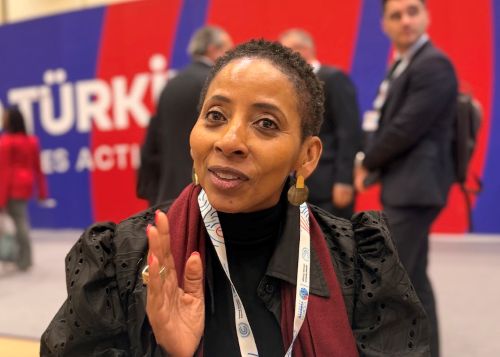
Catherine Kaufman, the Green Climate Fund’s regional director for Africa, speaks to bird story agency during a Q&A at COP31 in Antalya, Türkiye, on November 12, 2026. Photo: Seth Onyango, bird story agency.
The Green Climate Fund’s Africa director tells bird story agency at COP31 in Antalya that stronger local financial institutions, African investment and greater ownership of critical minerals would help the continent capture a bigger share of the green economy’s rewards.
By Seth Onyango, bird story agency
13 November 2026
Africa needs to look to its own banks, financial markets and institutions to fund its green economy, according to Catherine Kaufman, the Green Climate Fund’s regional director for Africa.
The continent has received $8.3 billion from the fund over the past decade, accounting for roughly 37% of its $22.3 billion global portfolio. But Kaufman says much of the GCF’s funding has historically been channelled through international institutions, leaving local financial institutions with a smaller role in managing investment.
“We also need to work on investments on the continent by the continent, as opposed to seeking constantly partners from outside the continent,” she told bird story agency at COP31 in Antalya, Türkiye.
Kaufman, who oversees the fund’s work across 54 African countries, said the GCF is increasingly helping African institutions develop the capacity to access and manage climate finance directly.
She also questioned whether Africa’s growing interest in processing its critical minerals would deliver lasting economic gains without greater ownership of the resources themselves.
She argued that African countries need to work together to protect their economic interests rather than pursue individual arrangements that weaken their bargaining power.
In this exclusive interview, Kaufman discusses Africa’s share of global climate funding, the barriers facing African investors and what the continent needs to do to finance more of its own development.
Q: The GCF has approved $3.3 billion in financing this year. How much of that is going to Africa, and how does the continent compare with other regions?
Kaufman: Generally, Africa enjoys about 40% of the whole book of the four regions. So it’s just under half.
The tally at year-end was about 37% of the total $3.3 billion. For the total $22.3 billion that we have funded in the last 10 years, Africa’s portion is $8.3 billion.
Q: Which African countries are struggling most to secure climate investment, and what is holding them back?
Kaufman: Our ambition is always to look for countries that are underserved, that are not getting the funding. When we look at Africa, we also map which ones still need money from us, and we try to go to those ones.
West African countries tend to struggle a little bit more with access to finance. Actually, it’s not access, but rather implementation once they receive access. I think that’s a language issue compared to Anglophone Africa, eastern and southern Africa.
Q: Where do you see the greatest opportunities to attract more investment into Africa’s green economy?
Kaufman: How we invest in Africa is based on what the regional strategies are.
We look at the African Union, we look at the African Continental Free Trade Agreement Secretariat and, for instance, the greening of trade corridors. So there are a number of interventions on the continent that we follow because those already have regional mandates and regional agency. And then, of course, we are very much focused on regional and national priorities. That’s what drives us.
What attracts private sector investment, or other investors besides public finance, tends to be where revenues are a little easier to generate, like in the renewable energy space, the mitigation space.
However, for Africa, the focus is very much on adaptation. That is where GCF plays a significant role because funding is scarce. It’s harder to fund adaptation because there aren’t usually ready cash flows.
Notwithstanding this, $3.1 billion of our $8.3 billion African portfolio is private sector money.
Q: African leaders often say the continent needs more climate finance. What should African countries themselves be doing differently to attract investment?
Kaufman: To catalyse more funding, we first of all need to make ourselves more investable.
But we also need to work on investments on the continent by the continent, as opposed to seeking constantly partners from outside the continent.
GCF is very much focused on strengthening local institutions to access finance. We provide different packages of grant funding to allow institutions to get equipped to manage climate finance.
For me, the one answer is to stop being externally focused and focus on strengthening our own institutions.
Most of our funding in the past has gone through international institutions. Eighty percent of our funding has gone to international institutions into the continent.
What we are doing more and more is helping the ones that are based in the region.
Q: Beyond access to international funding, what would make African countries more attractive to investors?
Kaufman: Stronger institutions, which means, from a public sector perspective, stronger governance, stronger fiduciary management and enterprise risk management.
Stronger institutions, stronger financial systems, so you can attract more capital and diversity of capital into the market.
If you’ve got strong financial markets, you have more liquidity. You can bring in green bonds. You can bring in guarantee structures. You can have better ways of dealing with local currency risk or foreign exchange risk.
We must also have people investing in early-stage project preparation capital, early-stage high-risk capital that will convert projects from ideas into actual investable pipelines.
GCF is great in that sense because we also match other financial institutions with blended instruments.
We can provide what multilateral development banks provide in terms of loans and guarantees. We can also provide equity capital, including really junior capital, which many development finance institutions cannot provide.
Q: Africa has vast reserves of minerals needed for the global energy transition. How can the continent use those resources to secure a greater share of the wealth they generate?
Kaufman: As GCF, we provide assistance to countries through readiness funding. Readiness is a grant that allows you to start thinking about what your policy should look like for climate finance.
It could help countries in the critical minerals space.
What should our policies look like? How should we make sure that we determine a future which creates livelihoods, jobs and prosperity for us?
GCF can unlock that through readiness funding.
Q: African countries often speak of negotiating together, yet many continue to strike individual deals over their resources. Is that weakening the continent’s bargaining power?
Kaufman, speaking in a personal capacity: As an African, I think it’s extremely important that we work together as a continent to determine policies that benefit all of us equally, and not divide-and-conquer policies.
It’s also important that we look beyond beneficiation. We think if we get beneficiation, that’s great. No, no, no. You must have ownership of your own resources.
Beneficiation is a byproduct of ownership. Otherwise, you’re always working for somebody else.
Q: With the current geopolitical tensions and pressure on international climate funding, do you expect Africa’s share of investment to grow?
Kaufman: The geopolitics are difficult. They are challenging, as you are aware, but for me that is just an opportunity.
The geopolitics really woke Africa up to some extent.
How do we become more self-sufficient? How do we contribute more towards our own climate finance future?
Last night, at the GCF event, one of the developing countries that we fund actually made a contribution itself. It made a pledge for its own climate finance.
That was the Solomon Islands.
It wasn’t much, around $400,000. Our contributors normally contribute hundreds of millions or billions.
But there is a signal that developing countries are making at the moment. They are saying that we are responsible for our climate ambition and our climate future.
We want to be equal partners, not just recipients, but equal partners in the investment of our future.
bird story agency
Leave a Reply