
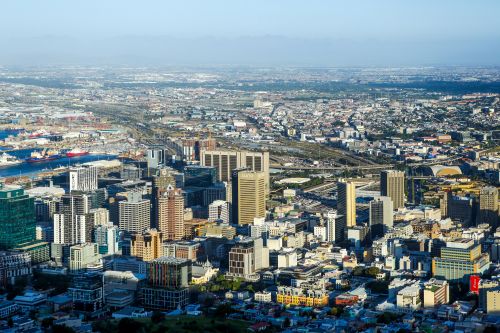
Cape Town’s city centre, seen from nearby Signal Hill (bird story agency/ Tom Kirkwood))
African cities are reclaiming degraded land, restoring wetlands and turning waste into resources to improve urban life. As populations grow, these efforts offer ways to build more liveable, resilient cities.
By Bonface Orucho, bird story agency
29 October 2026
African cities are increasingly reclaiming degraded land, restoring wetlands and recovering waste to address the environmental pressures of rapid urban growth.
From a former dumpsite in Kenya to restored wetlands in Rwanda and urban forests in Sierra Leone, local authorities are treating green spaces and waste systems as essential infrastructure for healthier, more resilient cities.
In Kisii County, (South Nyanza region in Kenya), a former dumpsite has become a public park, part of a wider effort to turn an environmental liability into a community asset.
The initiative reflects a broader shift in African urban development where populations are growing.
Cities are experimenting with ways to combine environmental restoration, public space and economic opportunity rather than allowing expansion to deepen existing infrastructure problems.
“These were not natural disasters. There was no earthquake, no act of God. These were the consequences of warnings ignored, of waste allowed to pile up year after year until the mountain became a grave,” Kisii Governor Simba Arati said in September 2026, referring to deadly landfill collapses in Uganda and Guinea.
His remarks underline the risks cities face when waste management fails to keep pace with urban growth.
The county government spent KSh 35 million (about US$270,000) transforming the former Nyambera dumpsite into ‘Etaya Governor’s Park’.
The site had long been associated with smoke, foul odours and health concerns for surrounding communities.
A 2020 study by Kisii University researchers found elevated concentrations of heavy metals in soil around the dumpsite and raised concerns about potential contamination of nearby water bodies.
Kenya generates an estimated 22,000 tonnes of waste daily, equivalent to about 8 million tonnes annually, according to the National Environment Management Authority (NEMA).
An estimated 60–70% is organic, presenting opportunities to convert discarded material into compost, fertilizer and other useful products.
A materials recovery facility established at the Kisii Agricultural Training Centre can process up to 50 tonnes daily, while a Black Soldier Fly unit has been designed to process 10 tonnes of organic waste into animal feed and fertiliser.
The facilities are intended to reduce the volume of waste sent for disposal while creating value from materials that would otherwise be discarded.
The county is also linking environmental improvement to employment. Through its ‘Kazi Mashinani programme,’ Kisii engages about 2,000 people monthly on a rotational basis to clean streets, clear drainage channels and maintain public spaces.
The county officials project that 24,000 people will benefit from the programme, although the figure represents anticipated reach rather than independently verified employment outcomes.
Similar efforts are taking shape elsewhere on the continent, where degraded land and ecosystems are increasingly being reconsidered as part of cities’ infrastructure rather than as vacant space for development.
In Kigali, Rwanda, the Nyandungu Eco-Park demonstrates how wetland rehabilitation can combine environmental protection with recreation and livelihoods.
Opened in July 2022, the 121.7-hectare park incorporates restored wetlands, forest, ponds and walking and cycling routes. The project restored natural habitats and planted 17,000 trees representing over 55 indigenous species, according to Rwanda’s environmental authorities.
The park is also part of a wider programme to restore urban wetlands. In January 2026, the World Bank outlined plans for five additional wetland ecosystem parks covering nearly 500 hectares across Kigali.
Backed by US$27 million in financing from the Global Environment Facility through the World Bank-supported Rwanda Urban Development Project and the Nordic Development Fund, the programme aims to reduce flood risks while creating public spaces and economic opportunities.
The World Bank projects that the five parks could attract more than one million visits annually by 2031, create 7,500 jobs and help avoid between US$45 million and US$90 million in flood damage.
In Addis Ababa, Ethiopia, the Beautifying Sheger initiative is applying a similar principle to river corridors. Launched in 2019, the programme aims to rehabilitate 56 kilometres of rivers and surrounding areas, combining environmental improvements with parks, walkways and flood-control infrastructure.
A 10.5-kilometre Entoto-Kebena riverside development covering 87.6 hectares was, In June 2026, inaugurated adding landscaped public space and infrastructure along the river corridor.
The city has also invested in waste-to-energy infrastructure. The Reppie plant, which began operating in 2018 on the site of a former landfill, was designed to process up to 1,400 tonnes of waste daily and generate 25 megawatts of electricity.
The facility illustrates the potential to connect waste management with energy production, although its actual operating performance and contribution to the city’s electricity supply need to be distinguished from its designed capacity.
In Freetown, Sierra Leone, the TreeTown initiative is using community participation and digital tracking to restore degraded landscapes and reduce environmental risks.
Launched in 2020, the programme initially targeted one million trees by 2023 before expanding its ambition to five million trees by 2030, with the broader goal of restoring 5,000 hectares.
By 2024, about 977,000 trees had been planted and digitally tracked, restoring approximately 1,000 hectares, according to programme figures cited by the United Nations Development Programme.
The initiative has also generated around 1,500 green jobs, with young people accounting for about 80% of those employed and women 48%, according to the reported figures.
The approach links tree planting to the long-term care of restored landscapes. Participants can receive income for maintaining trees, while digital tracking helps monitor planting and survival. In a city vulnerable to flooding and landslides, restoring vegetation in upper catchment areas can also help reduce environmental risks, although the scale of that benefit depends on tree survival, location and wider land-use management.
Lagos, Nigeria, is pursuing another dimension of the transition by building systems to recover value from waste. In February 2026, the state commissioned an organic-waste biodigester at Ikosi-Ketu Fruit Market.
The unit is designed to process 500 kilograms of organic waste daily, generating electricity for lighting and cold storage as well as cooking gas and fertilizer.
The pilot is relatively small compared with the estimated 16,000 tonnes of waste Lagos generates daily, but it demonstrates how decentralised recovery systems can serve markets and communities close to where waste is produced.
The Lagos Waste Management Authority has also reported that electronic waste processed through its system increased from about 306 tonnes in 2023 to 355 tonnes in 2024 and 405 tonnes in 2025.
The urgency of these initiatives is underscored by the scale of Africa’s urban expansion. According to the Organisation for Economic Co-operation and Development’s Africa’s Urbanisation Dynamics 2025, the continent’s urban population is projected to rise from about 700 million in 2020 to 1.4 billion by 2050.
That growth will increase demand for housing, transport, drainage, sanitation, energy and public spaces.
Oxford Economics’ Global Cities Index 2026 projects that major African functional urban areas will add 213 million people by 2050.
Of the 100 fastest-growing major city populations globally over that period, 70 are projected to be in Africa. African cities are also expected to account for more than half of employment growth across the 1,000 cities covered by the index.
Yet the report highlights a central tension: population and employment growth do not automatically translate into higher productivity or greater average wealth.
Accra, Dakar and Lagos are projected to expand employment in finance and technology, but Oxford Economics warns that shortages of relevant skills could leave these cities growing in size without comparable gains in prosperity.
The policy frameworks supporting such efforts are developing unevenly across the continent.
Kenya’s Sustainable Waste Management Act, 2022, provides a framework for waste separation and recovery. Rwanda’s wetland restoration programme links ecosystem protection with urban development, while Freetown’s tree-planting initiative has used community participation and digital monitoring to support restoration.
bird story agency
Leave a Reply