
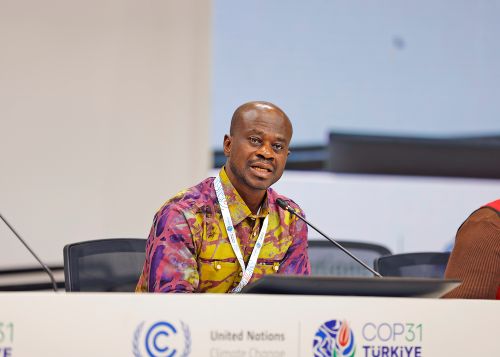
Dr Antwi-Boasiako the African Group of Negotiators chair speaking at the session on the sidelines of COP31 in Antalya, Türkiye. Photo by Seth Onyango, bird story agency.
At COP31, African climate campaigners warned that Brazil’s voluntary roadmap for moving away from fossil fuels could ease pressure on wealthy countries to provide the finance and technology African economies need to expand electricity access and build cleaner industries.
By Seth Onyango, bird story agency
16 November 2026
A plan to help the world move away from fossil fuels has drawn concern from African climate campaigners at COP31 over whether its voluntary approach will secure the finance and technology poorer economies need.
The roadmap, advanced by Brazil following last year’s climate summit in Belém, aims to help countries implement the agreement reached in Dubai in 2023 to transition away from fossil fuels in energy systems.
Philip Kilonzo of PACJA believes its voluntary nature could weaken pressure on wealthy countries to support that shift.
“Developed countries actually praised Brazil for delivering that roadmap for transitioning away from fossil fuel because it’s voluntary, it’s non-binding,” he told bird story agency in an exclusive interview in Antalya.
Kilonzo attended the high-level discussion on the proposal. He fears the roadmap could take the place of a stronger international agreement, allowing governments to announce transition plans without adequate scrutiny of their delivery or the support promised to poorer countries.
He said voluntary arrangements have a poor record of holding governments to account, allowing countries to announce targets and timelines without strong checks on whether they follow through.
Brazil published the roadmap on November 3 and presented it in Antalya on November 10. A contribution from the COP30 Presidency, it sits outside the formal negotiations and creates no new commitments.
It gives countries a framework to assess their dependence on fossil fuels, the obstacles to moving away from them and the investment required. Its indicators cover energy demand, supply and the broader economy, including fiscal dependence and financing costs.
The Dubai decision called on countries to contribute to a just, orderly and equitable transition through nationally determined action. It did not impose binding national fossil fuel phase-out schedules.
Developed countries nevertheless retain obligations under Article 9 of the Paris Agreement to provide financial resources to assist developing countries with emissions reduction and adaptation.
Kilonzo’s concern is that the voluntary process could reduce pressure to secure stronger financing arrangements, leaving African countries without clear answers on how their transition will be funded.
The stakes differ across economies with very different energy needs. More than half a billion people in sub-Saharan Africa still lack electricity.
The International Energy Agency’s 2025 electricity-access report estimated that achieving universal access across Africa by 2035 would require about $15 billion annually. Commitments towards new electricity connections in sub-Saharan Africa totalled less than $2.5 billion in 2023.
Nana Dr Antwi-Boasiako Amoah, chair of the African Group of Negotiators, says transition timelines must reflect countries’ development needs and dependence on fossil fuel income.
Responding to a question about national transition plans, he argued that schedules should account for historical emissions, levels of development and the revenues governments stand to lose. The biggest emitters have already developed, he said, and “we also have the right to develop”.
He warned against allowing African fossil fuel assets to become stranded. Faster timelines, he argued, would require developed countries to supply the finance and technology needed to make them possible.
African negotiators want room to set their own pace, while Kilonzo fears that flexibility for wealthy countries could weaken pressure to provide support.
PACJA executive director Dr Mithika Mwenda addressed Africa’s energy needs in a statement seen by bird story agency.
“Much of Africa is not transitioning from an established system of universal, reliable and affordable energy,” he said.
Mwenda welcomed the roadmap’s recognition of national circumstances. African countries, he argued, must expand their energy systems to meet rising demand while progressively reducing their carbon intensity. Progress should be measured through improvements in energy access, reliability, affordability and productive use, alongside emissions reductions.
He also called on wealthy nations to cut fossil fuel dependence faster, citing their greater historical emissions and financial and technological resources.
Brazil’s roadmap recognises that countries need different pathways. At its presentation, UN Secretary-General António Guterres urged governments to produce national plans with clear timelines, responsibilities and financing needs, and to demonstrate measurable progress by 2028. He also called on developed countries and development banks to coordinate finance and technology support around those plans.
Mwenda wants predictable, long-term funding that avoids adding to debt burdens or diverting money from essential services.
Financing costs already constrain electricity investment. The IEA’s 2025 report found that the cost of capital for electricity-access projects was three to four times higher than for grid projects in advanced economies. Lower financing costs could reduce project costs by 15–25%, making connections more affordable.
The industrial opportunities depend on reliable power, too. An OECD report published in October found that much of the value in critical mineral supply chains lies in processing, refining and manufacturing, activities concentrated largely in Asia, particularly China. Expanding those industries in Africa requires affordable electricity and finance, infrastructure and skilled workers.
Kilonzo said governments should use demand for their minerals to negotiate better terms on investment, technology and local production. He questioned whether they could secure those benefits while pursuing separate deals with foreign governments and companies, arguing that negotiating alone weakened their collective bargaining power.
Meanwhile, Mwenda called for investment in local manufacturing, skills and regional infrastructure, warning of “a risk that the transition will change the technologies powering the global economy without significantly changing Africa’s subordinate position within it”.
African negotiators are also seeking practical support through a separate just transition mechanism. Countries agreed at COP30 to develop it, with a decision on the process for putting it into operation due for consideration at COP31. Its stated purpose includes international cooperation, technical assistance, capacity-building and knowledge-sharing.
The broader COP30 just transition decision addresses affordable energy, clean cooking, workers’ rights, technology transfer and financial support. It also recognises that high debt burdens can hinder countries’ transitions and calls attention to the need for grants and highly concessional finance.
“So a transition without laid out means of implementation cannot be a just transition,” Amoah said.
Mwenda proposed assessing the roadmap through three questions: how countries can expand energy access and productive capacity while cutting emissions, what support will enable them to do so, and how progress will be measured.
That assessment, he said, should track the finance and technology delivered by developed countries as well as the improvements achieved in poorer economies.
But even as the fallout continues, Brazilian officials have stressed that the roadmap is only a call to action rather than a text to be negotiated, so any firmer commitments would have to come through other channels, such as the just transition mechanism.
Still, African campaigners fear that the roadmap’s voluntary nature may encourage wider participation, while leaving much of the responsibility for action and financing with individual governments.
For African countries, the outcome will influence decisions about electricity, industry, fossil fuel revenues and investment for years to come.
bird story agency
Leave a Reply