
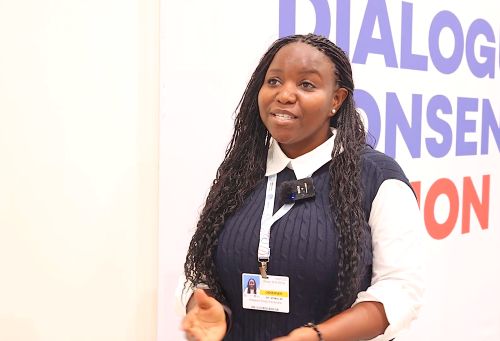
Kapwani Kavenuke, a lawyer and energy campaigner at Power Shift Africa, pictured on November 10, 2026. Photo: Seth Onyango, bird story agency.
The COP31 presidency wants electricity to make up 35% of global energy use by 2035, but African countries question how it will be financed and whether it can support industrial growth.
By Seth Onyango, bird story agency
10 November 2026
A proposal to accelerate global electrification has emerged as one of the major energy initiatives at COP31, placing Africa’s electricity needs and the cost of expanding power infrastructure firmly in the climate debate.
The Turkish presidency is seeking support for a target that would increase electricity’s share of global final energy consumption to 35% by 2035, from around 23% today.
The initiative, known as the 35 by 35 pledge, is intended to encourage governments to expand electricity use across transport, industry, buildings and other sectors.
COP31 President Murat Kurum has described the target as an attempt to establish a clear international goal for electrification, linking the initiative to energy security, economic growth and the need to reduce dependence on imported fuels.
“We need the 35-by-35 target because until now electrification has not been underpinned by a clear global goal,” Kurum said.
Chris Bowen, Australia’s climate minister and COP31 President of Negotiations, has placed particular emphasis on the investment needed to make the target achievable.
“Ambition matters, but it must be backed by investment, infrastructure and implementation,” Bowen said.
For African countries, the proposal comes at a time when expanding electricity access has become central to economic planning. Governments are investing in generation, transmission networks and regional power markets to support manufacturing, mineral processing, agriculture and rapidly growing urban populations.
Yet the scale of the investment required remains considerable. Roughly 600 million people in sub-Saharan Africa were living without electricity in 2024, according to the International Energy Agency. Many more households and businesses contend with unreliable supply, expensive backup generators and power systems unable to meet rising demand.
The proposed target has therefore opened a discussion about the financing arrangements, energy choices and national priorities that would determine how African countries participate in a global electrification drive.
Kapwani Kavenuke, lawyer and an energy campaigner at Power Shift Africa, said the initiative needed to reflect the circumstances of African countries, where access to electricity remains a major development challenge.
“Electrification is a good way to go because we are trying to transition away from fossil fuels,” Kavenuke told bird story agency on the sidelines of COP31.
She said the continent’s priorities should include expanding access to renewable electricity in communities still outside existing power networks, alongside efforts to improve electricity efficiency.
African negotiators are expected to examine how the initiative accommodates different levels of development and the substantial investment required to expand electricity supply across the continent.
Their position could influence whether the target is incorporated into the final COP31 outcome, and under what terms.
The financing question
The scale of Africa’s electricity deficit provides a measure of what is at stake.
The IEA estimates that annual financial commitments for new electricity connections in sub-Saharan Africa remain below $2.5 billion, with concessional finance needing to increase roughly sixfold to support universal access goals.
The African Development Bank and World Bank have already placed electricity access at the centre of their development programmes through Mission 300, an initiative intended to connect 300 million Africans to electricity by 2030.
The programme is expected to mobilise public and private investment, expand national grids, support decentralised renewable energy systems and encourage regulatory reforms that make electricity projects commercially viable.
Its progress will offer an important test of whether international financing can translate into connections at the pace required.
The financing discussion gained fresh momentum on Tuesday with the launch of the Electrify Now Finance Coalition, bringing together governments, development banks and private financial institutions to support electrification in emerging and developing economies.
The World Bank and African Development Bank will become the coalition’s inaugural co-chairs in 2027, placing two institutions already involved in Africa’s electricity expansion efforts at the centre of the new initiative.
The COP31 presidency is also working with the International Renewable Energy Agency on a programme to help developing countries identify distribution grid investment needs, prepare projects and access finance.
For African governments, financing also extends to the terms on which money is available. High borrowing costs, currency risks and the financial condition of national utilities can make otherwise viable power projects difficult to finance.
Transmission networks require large amounts of capital upfront and often generate returns over several decades. Distribution companies must also recover enough revenue to maintain equipment and invest in new connections, while keeping electricity affordable for consumers.
These challenges are particularly acute in countries where public debt already consumes a significant share of government revenue.
Kavenuke said Power Shift Africa was pressing for grants to play a larger role in financing electrification, particularly for communities with limited access to existing electricity networks.
“What we are pushing for is instead of having loans in order to finance electrification, it needs to come in terms of grants,” she said.
She also called for greater involvement of civil society organisations in directing financing towards community-level projects, drawing on her experience working with communities in Uganda and Zanzibar.
The financing demands have also gained support from a coalition of civil society organisations pressing the COP31 presidency to strengthen the proposed electrification framework.
In an open letter updated ahead of the summit, more than 120 organisations called for significantly increased public climate finance, with grants and concessional funding directed towards developing economies.
The signatories also want financing to reach smaller enterprises, community energy providers and local organisations, arguing that the expansion of electricity networks must be accompanied by measures to improve affordability and access.
The proposed COP31 pledge could provide a framework for increasing international investment in electrification. Its value for African economies will depend in part on how financing is mobilised, the instruments available and the extent to which support reaches countries facing the greatest electricity deficits.
Electrification and industrial growth
Africa’s electricity needs extend well beyond household connections.
Reliable power is increasingly important to the continent’s efforts to process more of its agricultural produce, manufacture consumer goods and capture greater value from its mineral resources.
Countries including Zambia and the Democratic Republic of Congo are seeking to expand mineral processing and related industries, while South Africa, Morocco and Egypt are pursuing investments in manufacturing, renewable energy and cleaner industrial production.
These ambitions depend on electricity systems capable of supplying large industrial customers at competitive prices.
The challenge is particularly important for Africa’s position in global supply chains. As international markets introduce stricter environmental requirements, the cost and carbon intensity of electricity could increasingly influence where manufacturers choose to invest.
For countries seeking to develop battery materials, green steel, fertiliser production and other energy-intensive industries, electricity policy has become closely linked to trade and industrial strategy.
Damilola Ogunbiyi, chief executive of Sustainable Energy for All and the UN Secretary-General’s Special Representative for Sustainable Energy for All, has identified industrial development as one of the major opportunities associated with the proposed target.
“Electrification presents an opportunity to industrialize, create jobs, improve livelihoods and strengthen energy independence,” Ogunbiyi said.
Sustainable Energy for All has worked with the COP31 presidency on a new report, The Electrification Opportunity, examining the challenges and opportunities facing emerging markets and developing economies.
Kavenuke expressed a similar view, arguing that renewable-powered electrification could create economic opportunities for communities and support the development of African industries.
“It’s not just about household lighting. It’s not just about having e-mobility or e-cars. It’s about economic transformation and what opportunities then does it bring?” she said.
The 35 by 35 initiative could provide additional momentum for investment in these sectors, particularly if international financing supports generation capacity, transmission infrastructure and regional electricity trade.
It also raises questions about how the benefits of electrification will be distributed. Large industrial projects may attract financing more readily than rural distribution networks or smaller enterprises, even as both contribute to economic development.
The terms of international support could therefore shape which parts of African economies gain access to new electricity supplies and at what cost.
The debate over energy sources
The COP31 initiative is also attracting scrutiny over the sources of electricity that would support the proposed expansion.
In an analysis published ahead of the summit, the Heinrich Böll Foundation argued that the pledge leaves considerable room for governments to increase electricity consumption using fossil fuel generation.
The foundation pointed to language referring to diverse and sustainable energy sources, arguing that the proposal needs stronger provisions linking electrification to renewable energy and the transition away from fossil fuels.
The concern has also surfaced in the wider international debate. Portugal has advocated cleaner electrification, while climate-vulnerable Pacific countries are seeking clearer progress on reducing fossil fuel dependence, according to Reuters.
The COP31 pledge already recognises renewable energy, energy efficiency, nationally determined policies and the need for affordable finance. It also calls for investment in grids, storage and decentralised generation, including through grants and concessional instruments for developing economies.
Power Shift Africa is among the organisations calling for a stronger emphasis on renewable energy within the proposed electrification framework.
“Our position is it must push forward for renewables,” Kavenuke said.
She argued that renewable energy investment could help countries expand electricity access while developing local industries and creating employment.
The distinction between expanding electricity consumption and increasing renewable generation matters for African countries, where national energy systems differ considerably.
South Africa continues to depend heavily on coal, while countries including Kenya and Ethiopia generate substantial shares of their electricity from renewable sources. Natural gas also features in the electricity development plans of several African economies.
These differences will influence how governments approach an international electrification target and the financial and technological support they seek.
Africa also has significant renewable energy resources, including solar, wind, hydropower and geothermal potential. Developing these resources at scale requires investment in transmission, storage, regional interconnections and electricity markets capable of attracting long-term capital.
The COP31 presidency is seeking to address some of these infrastructure challenges through an international programme on distribution grids, supported by IRENA, and a tracking mechanism led by the IEA to monitor electrification progress.
IEA Executive Director Fatih Birol said electric technologies were increasingly competitive and could improve energy security for countries dependent on imported fuels. The agency will support the COP31 initiative by monitoring global and regional electrification trends.
“Electric technologies are often cost-competitive and can improve energy security for fuel importers,” Birol said.
Utilities participating in the Utilities for Net Zero Alliance have also increased their annual investment commitment for grids, renewable energy and storage from $148 billion to $156 billion.
A global target, different national realities
The proposed 35% target measures electricity’s share of final energy consumption globally. It does not prescribe an identical target for every country.
This is an important consideration for African economies, where electricity consumption remains low, and access gaps are substantial.
An increase in the global share could be driven largely by electric vehicles, industrial equipment and heating systems in economies that already have extensive electricity networks.
For many African countries, the immediate priorities include building those networks, connecting households, expanding generation capacity and providing sufficient electricity for economic activity.
Kavenuke said the proposed timetable needed to be considered alongside the practical challenges facing communities that have yet to gain electricity access.
Drawing on her work in Uganda and Zanzibar, she said some communities still rely heavily on charcoal and other traditional fuels for cooking and have limited access to electricity infrastructure.
“So when you go present this idea to people in those grassroots communities about we want to do this by 2035, which by the way is just around the corner, they are saying how?” she posed.
The pace of electrification will therefore depend on national circumstances, available technology, investment conditions and the structure of domestic energy demand.
The pledge acknowledges these differences through its emphasis on nationally determined policies and development priorities.
African negotiators will have an opportunity to establish how those provisions should be reflected in any wider COP31 outcome and whether additional language is needed on finance, access and implementation.
The COP31 presidency has presented electrification as a central part of its effort to accelerate implementation of existing climate goals.
Its progress in Antalya will provide an early indication of how governments intend to translate those goals into investment and national energy policies.
For Africa, the discussion comes as governments and development lenders seek to accelerate electricity connections through Mission 300 and attract investment in generation, transmission and industrial power supply.
bird story agency
Leave a Reply