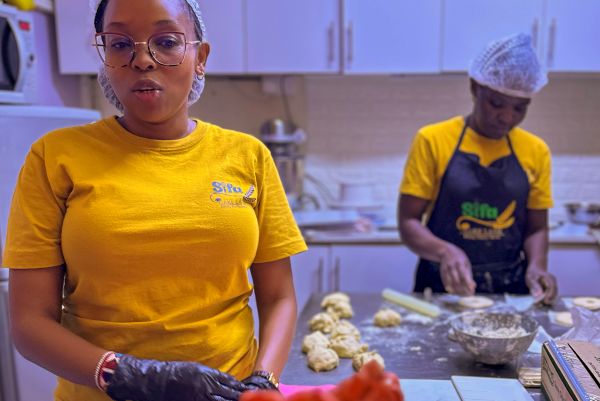
Faith Siele, Sifa Cake Land founder, is demonstrating how to make cake decorations at her business in Embakasi, Nairobi while a staff member is working in the background on February, 12, 2026. Photo: bird story agency.
Inside Nairobi’s Nyayo Estate, one of Africa’s largest gated residential communities, a digital platform has become a safe space for mothers and women in business to learn, share and add value to their cherished neighborhood.
By Finley Maranga for bird story agency
The families in thousands of homes in Nairobi’s Nyayo Estate stir as dawn rays hit their uniform rooftops. Social entrepreneurs Maureen Amakabane and Njoki Mwangi are already on the move. They run Nyayo Moms Sokos (NMS), a social commerce (selling via WhatsApp or Facebook) platform for women-owned businesses that serves the estate’s residents. Most global e-commerce systems rely on Western-built tech to reduce the risks typically associated with anonymous online transactions. However, the use of regional fintech ecosystems is rising around the world.
Amakabane, Mwangi, and the other NMS co-founder Martha Owuor, prioritise social collateral instead, powered by a low-entry tech stack that leverages social media, mobile money payments, specialised business training, neighbourhood events. The three women initially created NMS to support other “mom-preneurs” in 2019. They significantly formalised and gained momentum in 2020. The growth was largely driven by the COVID-19 pandemic, which accelerated the need for a vetted digital community where residents of Nyayo Estate could trade safely and reliably. The founders say NMS now has around 5,570 registered users.
Owuor runs a home renovations business. As a pioneer member of the Nyayo Embakasi Residents Association, Martha Owuor has been involved in the estate’s administration and governance since 2001.
“Nyayo Embakasi is one of the largest estate gated communities in East and Central Africa, perhaps even Southern. And we have a total of about 4,800 houses in a gated community with three gates. So that gives us a population of about 20 to 25,000 people living in a gated community,” says Owuor.
A retired tourism professional, Owuor relied on her background in management and quality control to establish operational and governance systems that give visibility to businesses that were previously confined to private homes.
Women entrepreneurs first undergo a vetting process. Once cleared, they are given access to the NMS’s WhatsApp markets and regular training on inventory management and digital marketing. Finally, the platform facilitates the sale by connecting these verified vendors to a ready pool of buyers within the network. They also use data-driven tracking and human oversight to ensure every delivery and payment is completed reliably and safely.
Amakabane leads strategy, business development, and training. She is a vocal advocate for leveraging technology to drive financial inclusion for African women and has founded additional ventures, such as Usafi Sanitation Ltd, while also serving as a storyteller instructor with The Moth.
“We’ve created a very safe space where women can come in and transact. So for us, we want women to feel safe when they walk into a community, even with an idea, and they’ll find a place where they can trade and transact without feeling that it’s too small or it’s too big. So that’s a metric for us for success. And we’ve been able to see businesses that have been birthed within the platform, and because there’s an existing marketplace, then they’re able to trade, transact, and grow their business.” says Amakabane.
Njoki Mwangi is a certified Marriage and Family Therapist with a legal background, holding a Bachelor of Laws (LL.B) and a Master of Arts in Marriage and Family Therapy. As a community leader for Nyayo Moms Sokos, she advocates for mental well-being and provides legal consultancy to support the holistic growth of women entrepreneurs.
The rise in mental illness and family dysfunction during COVID pushed her to advertise her practice on NMS and encourage the platform’s diversification from food and household goods.
“And that’s the first time actually, I thought, “How do I bring in my legal services and my mental health?” Very few people knew me as a lawyer, very few people knew me as a counsellor, only the ones that I would be able to interact with. And so for the first time, I started working on my flyer and I’m not very good at- is it called digital something? Doing flyers and all that. And started working on my flyers and advertising myself,” said Mwangi.
NMS is a lifeline for women like Faith Siele. When her husband’s surgery left their family without its sole breadwinner, Siele transformed her baking hobby into a professional brand. The results were quantifiable: while Siele was away on a leadership program in India for eight months, she says her business grew five times over – a testament to the formalised systems NMS helps women build.
“I had been a home baker, and when I got this shop, believe it or not, I would lock myself inside because I was the only employee and I was so scared of having – being overwhelmed by orders. So I would close my doors and I would bake and take my two orders a day very comfortably. And Nyayo Moms Soko by then – I opened this shop in 2019 and 2020, as you all know, COVID happened. And by then I had joined Nyayo Moms Soko, and to be honest, when people were closing, when COVID shut all business – there were no events, we moved from catering weddings of a thousand to 20, 50 – Nyayo Moms kept my business running,” says Siele.
NMS’s founders say 32% of the women registered on their platform have successfully transitioned from informal “side hustles” to growing businesses. Amakabane and the other founders are tightlipped about revenues for women’s protection. Men are charged a premium to sell on the platform, but do not have access to other benefits like training.
According to the International Finance Corporation (IFC), closing the gender gaps in sales between men and women vendors on African e-commerce platforms could add US$14.5 billion to the value of the continent’s e-commerce market between 2025 and 2030.
Dr. Shiko Gitau, CEO of the Nairobi-based tech agency Qhala, works with African organisations like NMS to scale using data-driven strategies and emerging technologies. She argues that African tech solutions often falter when they are not grounded in the continent’s specific social nuances.
“They’ve extended this social trust and collateral to women who are in their ecosystem and their community. Such that if I say, ‘I’m a Nyayo Mum’s mum,’ or ‘I’m a Nyayo Mum’s trader,’ or ‘I’m selling in Nyayo Mum’s market or Soko,’ people will trust me because Nyayo Mum is known. And I can go to Nyayo Mum or Nyayo Estate and say, ‘I want to talk to Maureen. Maureen, I bought my handbag from this person and it’s torn. You see? That is the assurance that somebody wants in their head,’” says Dr. Gitau.
The United Nations Conference on Trade and Development (UNCTAD) reported last year that high operational costs and unreliable internet prevent many women-led firms from moving beyond social commerce to formal e-commerce platforms.
The three women are already working on a project that adapts and scales their successful hyperlocal framework, to help ensure that the “invisible” work of Africa’s women-led SMEs becomes a formalised, measurable driver of the continent’s growing digital economy.
“So the affirmation from day to day interactions with the women as you just walk in the community and actually get to see the women grow and and the business grow and even myself, when I look at myself when I started the business and now I’m a totally different person. So even just being able to shift the business to meet more of the customer needs than the passion that I had when I was starting,” says Amakabane.
Leave a Reply