
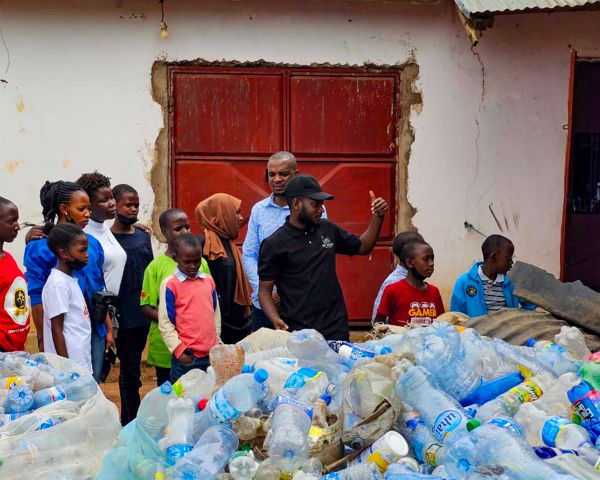
Patrick Kipesha, CEO of Eco – Friendly Recycling educating students on the importance of taking care environment Malimbe, Mwanza. Photo Courtesy: Patrick Kipesha
In Tanzania, two Gen Z-ers began picking up discarded plastics in their neighborhood back in 2023. Today, they’re social innovators with plans to build a factory to transform plastic waste into tiles. Bird talks to one of them about how their initiatives are helping the government to achieve its environmental sustainability goals while at the same time, providing income opportunities for women and youth.
By Twaha Mruma for bird story agency
Three years ago, two young men began walking the streets of Mwanza, Tanzania’s second-largest city, sacks in hand, collecting discarded plastics. With no machines, no funding, and some hope, Patrick John Kipesha and Ignatius Anchar Mushi soldiered on, driven by a simple conviction of keeping their neighbourhood clean.
What started as an almost solitary endeavor would later gain momentum in April 2023 when the duo formally registered Eco Recycling, a community-based organisation to build a sustainable plastic collection and buy-back system. At the time, they were barely collecting half a tonne of plastic waste each week. As word spread, waste pickers began to join in. Volumes increased, and the modest ambition of cleaning up a single neighbourhood slowly evolved into a city-wide intervention.
“It’s unbelievable now, what started as a personal conviction has, over the past few years, grown into a community solution,” Kipesha recalled in an interview with bird.
On his Instagram page (@patpio_mseminari), Kipesha, who describes himself as a pan-Africanist, as well as a climate and environmental enthusiast, posts videos and photos of the local recycling movement that he helped launch.
Today, the initiative he started with Ignatius operates under Eco-Friendly Recycling (ERF), working closely with young people and women from surrounding communities, creating income opportunities through plastic collection, sorting and resale. Collected waste is sold to nearby factories where it re-enters the production cycle as raw material.
“Many people still see plastic as something to throw away, not as a resource,” Kipesha said.
To change this perception, ERF blends community education with financial incentives, working alongside local leaders and schools to promote plastic segregation and recovery. As of 2025, ERF diverts between 30 and 50 tonnes of plastic waste every month, which is roughly 500 tonnes annually, away from landfills and open dumping sites. The organisation estimates it has created between 10 and 60 direct and indirect income opportunities, largely for young people, affirming waste recycling’s potential as an urban employment pathway, that can help to fix huge unemployment in the city. Within the next five years, ERF aims to establish a small factory to process plastic waste into construction tiles.
The founders expect to tap into a huge opportunity. Tanzania generates more than one million tonnes of plastic waste annually, yet less than four per cent enters the formal recycling stream. While about 40% of plastic waste is collected, weak enforcement, financing gaps and limited household-level segregation Kipesha listed among factors that continue to undermine progress. The duo’s vision is to raise plastic recovery rates in Mwanza before scaling the model nationally.
Experts have however cautioned that community action alone cannot solve the plastic crisis without strong policy support. Tanzania has taken steps, including the 2019 ban on plastic carrier bags, which outlawed their manufacture, importation, sale and use on the mainland, with penalties for non-compliance. Despite this policy intent, implementation remains uneven. At the launch of the National Plastic Action Partnership in September 2025, Dr. Peter Msoffe, the deputy permanent secretary for the environment in the Office of the Vice President, described plastic pollution as a cross-cutting challenge requiring collaboration, innovation and decisive action.
Comparisons across the region shows countries like Tanzania can benefit from stronger enforcement and innovation for better waste management. Rwanda’s strict plastic bag ban, in place since 2008, Kenya’s tough ban on plastics in 2017 and later introduced mandatory Extended Producer Responsibility regulations under the Sustainable Waste Management Act of 2022 for instance have transformed urban cleanliness in these countries. South Africa, meanwhile, operates a market-driven system that compels producers to finance recycling through its National Environmental Waste Act of 2021.
“Infrastructure and policy matter but without behaviour change, nothing moves. People must see waste as something with value,” said Kipesha.
Financial sustainability remains ERF’s biggest challenge. The organisation currently relies on recycling revenues, small grants and partnerships, a model Kipesha said constrains growth. Access to infrastructure grants, blended finance, and emerging plastic and carbon credit mechanisms would significantly strengthen its long-term impact.
bird story agency
Leave a Reply