
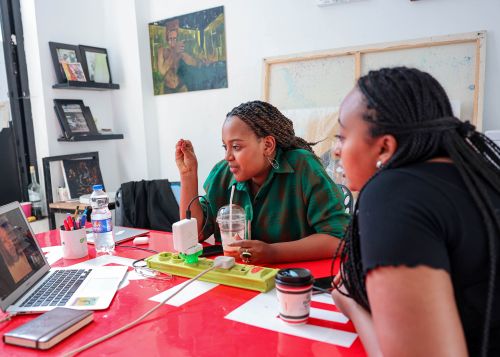
Studio 11 co-founder, Nafkot Gebeyehu, (left) speaking with co-founder, Zion Yaynu, during a video call at the gallery in Addis Ababa, Ethiopia, on July 1, 2026. Photo: Solan Kolli, bird story agency
Two artists in Addis Ababa set out to find their own studio. Instead, they established a gallery and residency program to help rising female artists advance their work and careers.
By Solan Kolli, bird story agency
Outside, traffic flowed through Addis Ababa’s busy Bole district. The hustle and bustle of Ethiopia’s capital gave way to a bright gallery where paintings covered the walls, handmade prints adorned display tables, and young artists discussed ideas as visitors paused to admire and purchase their work. It was hard to believe that the gallery began simply because two artists needed a place to work.
When photographer Nafkot Gebeyehu and painter Zion Yaynu originally shared a small studio in Addis Ababa, they had no intention of opening a gallery.
The two women met in 2021 while working for the same health technology company. Zion had recently returned from Australia to pursue painting full-time, and Nafkot was establishing a freelance photography career.
In 2022, they rented a studio for Zion to paint and Nafkot to develop her photography, which they named Studio 11. At the time, it was just a shared space where they worked on their respective projects, not a gallery.
Friends who visited suggested they use the space to host exhibitions.
“We didn’t know anything about curating shows,” Nafkot said. “We were just artists.”
For Zion, Studio 11 grew from paying attention to what artists around them lacked.
“It wasn’t something we intentionally set out to open,” Zion said. “It happened over time as we realised there was a need for it.”
Initially, new artists simply wanted a location to showcase their work, network with other creatives, and be treated seriously. But as more artists stepped through the doors, Nafkot and Zion realized the demand extended beyond the exhibition area.
“It wasn’t just about having a space,” Zion said. “People also needed guidance, training and connections.”
For curator and Addis Ababa University lecturer Mifta Zeleke, such initiatives are part of a wider movement of women artists who are helping reshape Ethiopia’s contemporary art scene by creating the opportunities they have often lacked.
“Women artists have been among the leading contributors to Ethiopia’s contemporary art scene. While challenges of visibility remain, they have also created opportunities through initiatives and studios such as Nubia Visual Art Studio. Women continue to play a leading role in shaping the country’s contemporary art landscape.”
Aside from galleries and studios, Mifta believes artists require deeper linkages to foreign marketplaces to help their work reach a wider audience.
“We need stronger connections between artists, writers, historians and critics, together with studio spaces, exhibition venues, fairs, biennials, conferences and stronger galleries that can connect Ethiopian artists with international audiences.”
As the joint workshop transformed into a gallery, the pair learned how to choose exhibitions, install artwork, and help artists.
Across Addis Ababa, many young artists exhibited their work in hotel lobbies, cafés, and restaurants, but the city’s limited gallery scene was heavily populated by established names. Despite Ethiopia’s strong artistic legacy, possibilities for emerging modern artists are limited, forcing many early-career artists to rely on informal places to build themselves.
“So they weren’t being taken seriously as artists,” Nafkot said. “There are a lot of women who have amazing work, but weren’t showing as often, we decided, okay, this is the gap we’re going to fill.”
According to UNESCO, the cultural and creative industries employ approximately 50 million people worldwide, with nearly half of them being women, highlighting the growing economic relevance of ensuring women have equal access to opportunities in the industry.
Today, Studio 11 has grown beyond exhibitions. Since its founding, the gallery has featured 15 women artists. Its newest venture, an artist residency programme, provides aspiring artists with specialized studio space, mentorship, and professional advice to help them develop their work.
“The idea behind the residency programme is for the artist to be in one location where they can come every day and build a body of work,” Zion said. “We help them strengthen their concepts, offer mentorship and practical training that they can continue using after the residency.”
Ruth Getachew, a 27-year-old visual artist, became the programme’s first resident. Working from the residency studio, she has been preparing for her first solo exhibition and receiving regular feedback from the gallery’s founders. She is a graduate of Addis Abeba University’s Alle School of Fine Arts and Design, and she believes the residency addressed one of the most significant challenges that new artists face.
“Most of the time, the biggest challenge for artists my age is space; especially for female artists,” Ruth said.
For Ruth, the residence provided more than just a space to work. It gave her support while her ideas were still developing.
“An exhibition happens after the work is already finished,” Ruth said. “But assisting artists while the work is still in progress and being created makes it even more supportive.”
Nafkot and Zion believe that helping artists before their work hits gallery walls is just as vital as showing finished items. Building such assistance, however, has required them to learn as they go.
When they started organizing exhibitions, neither had any experience running a gallery. They learnt via trial and error how to choose events, handle funds, cover operational costs, and fairly compensate artists while attempting to establish a sustainable entity.
“That was the biggest challenge,” Nafkot said. “It still remains one of the biggest challenges we have.”
The uncertainty has not disappeared.
“I question whether we will succeed or not every day,” she said. “We worry if we’re a sustainable business. We worry if this is going to be open a year from now, a month from now.”
Despite the hurdles, Nafkot and Zion are already thinking beyond the gallery they had envisioned. Their long-term goal is to establish a larger creative hub where artists can collaborate, interact directly with guests, and build sustainable professions.
Visual artist Afomia Admasu believes spaces like Studio 11 are helping more artists see a future for themselves. A finance manager by profession, she first discovered the gallery through its exhibitions and social media before exhibiting her own work there twice.
“I think Studio 11 is more than a gallery,” Afomia said. “I think it’s a community, and it offers opportunities for everyone. It’s very inclusive, and it’s also empowering. I like how it is open to everyone who’s willing to try.”
Back in the residency studio, Ruth continued layering paper, paint and textured materials as she prepared for her first solo exhibition. For her, the significance of Studio 11 was more than just the work that was created there.
“When they see us,” Ruth said, “I think they will feel more hopeful.”
That hope represents what Nafkot and Zion have been working toward since they initially hired a small space to create their own work.
They established an environment for other artists to conceive a future in which their work belongs not in hotel lobbies or borrowed corners, but at the heart of Ethiopia’s evolving art scene.
Leave a Reply