
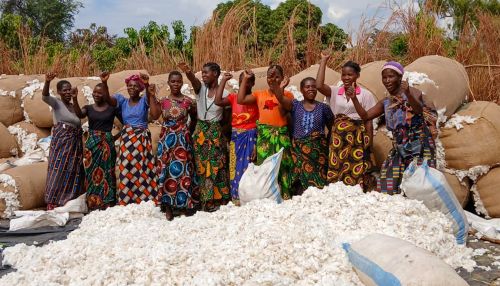
Members of the Mkuyu Women Group packing their harvested cotton for sale at the Nankumba Cotton Depot in Mangochi District, Malawi, on July 18 2026. Photo: Maureen Kawerama, bird story agency
A women’s farming group in southern Malawi is reinvesting cotton earnings in poultry, livestock, shops and savings schemes—turning a seasonal crop into year-round income, new jobs and greater financial independence. Their progress also shows what Malawi’s struggling cotton sector could deliver if persistent problems with seed, prices and market access are addressed.
By Maureen Kawerama, bird story agency
As the first rays of sunlight spread across the cotton fields of Mbapi in Mangochi District, southern Malawi, Juliana Samuel walks slowly between rows of harvested plants, pointing beyond the empty stalks to a modest brick house topped with shiny iron sheets.
“Everything you see here came from cotton,” she says with a smile. “I was once renting a house and struggling to provide for my children. Cotton changed my life.”
For Samuel, a single mother and chairperson of the Mkuyu Women’s Group, cotton is much more than a cash crop: It is the foundation upon which she has built a permanent home, started a grocery business and regained financial independence.
Her story mirrors that of 24 other women in the group, who have transformed seasonal cotton harvests into lasting economic opportunities not only for themselves but also for their wider community.
Founded in 2018, the group cultivates a shared 0.4-hectare cotton field (about 4,000 square metres), while the members also manage their own individual plots. The collective approach allows them to combine labour, share knowledge and invest their earnings in projects that benefit everyone.
According to Mkuyu group chairperson, Juliana Samuel, during the 2025/2026 farming season, the group harvested six bales of seed cotton from its communal field, earning approximately MK1.2 million (about US$670) after selling the crop.
Instead of sharing the money among the members, the group reinvested much of it into the future by repairing the group’s poultry house; purchasing chicken feed, medicines, and a backpack sprayer for cotton production. Some proceeds were saved through a village savings group.
The investment builds on an earlier milestone: In 2022, after earning MK1.6 million (about US$890) from cotton sales, the women constructed the chicken house and established a poultry enterprise.
Today, the project has grown to nearly 80 laying chickens, supplying eggs and chickens to local restaurants, while providing the group with additional source of income beyond the cotton season.
“The profits from cotton don’t end with cotton,” Samuel explains. “We use them to build other businesses that continue bringing money throughout the year.”
Expanding income for annual support
Those businesses have become an important buffer against the seasonal nature of cotton farming, a development experts applaud.
“Cotton farming is seasonal,” explains local agricultural economist, Leonard Chimwaza. “Farmers receive income between April and June, so they need to invest in other economic activities that generate money throughout the year, effectively reducing poverty and improving household resilience through multiple streams of income.”
For Samuel, every cotton harvest has marked another step forward.
After harvesting five bales from her one-acre field during the 2018/2019 season, she earned MK600, 000 (about US$335) from which she spent MK350, 000 (about US$195) on molding bricks for her first permanent home, while she used the remaining money to buy maize, Malawi’s staple food, for her family.
The following season, with improved prices, Samuel earned MK950, 000 (about US$530) from her cotton sales and she started the construction of her house. The determined farmers further invested some proceeds back in cotton production materials.
But that was not all: Samuel also ordered the first stock for her small grocery business.
Her most recent harvest brought MK1 million (about US$560) and around MK700,000 (about US$390) went towards roofing of the house, while the remaining cash helped her build a permanent room that will soon become her grocery shop.
“My dream is to own a big grocery shop,” Samuel says. “I believe cotton will help me achieve it.”
Knowledge that raises farmers’ returns
Across the village, 42-year-old Doreen Kasoka tells a similar story.
Before joining the Mkuyu Women Group, Kasoka had grown cotton for five years but she struggled to make meaningful profits due to lack of technical knowledge.
But everything changed after becoming part of the women’s group where training in improved farming practices significantly increased her productivity, allowing her to turn cotton into a profitable business.
During the 2024/2025 season, the profits enabled her to build the house where she now lives.
“This is my house,” she says proudly, pointing towards the newly built structure. “Cotton built it.”
The following season proved even more rewarding for Kasoka as she earned MK2.8 million (about US$1,560) from cotton sales, and she spent part of the money in buying goats to begin livestock farming, while another portion was used to pay school fees for her children.
“Cotton has changed my life,” she says. “I encourage other women to start growing it because it can remove families from poverty.”
For another member, 42-year-old widow, Bessie Maliwata, the crop has brought dignity after years of hardships of providing for the family single-handedly.
“Previously, I couldn’t easily pay school fees or provide for my children,” she recalls, adding: “But since I joined cotton farming in 2018, life has steadily improved.”
Today, Maliwata supports four children – including one in university- using income earned from cotton; and she has also invested in 15 chickens and 12 goats, creating additional income streams that strengthen her household’s resilience against future shocks.
Investing beyond the cotton field
Similar success stories are also reflected broadly in parts of Malawi’s cotton-growing areas, including Neno, another southern region district where organised farmer groups are treating cotton as a business by following recommended farming practices, and investing their profits into new enterprises.
Grace Mbekeyani, an agricultural extension officer working under African Institute of Corporate Citizenship (AICC), acknowledges how women are increasingly using cotton income beyond meeting immediate household needs.
“Cotton is no longer simply a cash crop for many women,” she says. “It has become a pathway to education, entrepreneurship and financial independence as the women establish businesses such as poultry production, grocery shops, irrigation farming, tailoring and soap making.”
The AICC’s Women’s Economic Empowerment in the Cotton Value Chain project, implemented with support from We Effect and the Embassy of Sweden, has strengthened this transition by training thousands of smallholder farmers in financial literacy, climate-smart agriculture and business development.
The initiative supports 2,400 cotton farmers in the area alone, while around 2,200 participate in Village Savings and Loan Associations that help them save, borrow and invest in productive enterprises.
A sector operating below its potential
Beyond improving the group members’ household incomes, the cotton benefits extend to the wider rural economy through seasonal employment, as evidenced by 48-year-old family man, Leonard Gray, who is among five workers for the women’s Group.
“The money I earn here helps me support my family,” he says. “It also helps me invest in my own cotton farming, and pay school fees for my children.”
But while the stories of Samuel, Kasoka and Maliwata demonstrate cotton’s transformative potential, challenges such as access to markets; low prices; delayed delivery of seed; poor germination rates; and increasing pest infestations continue to threaten the sector
According to the Mkuyu Women’s Group, the nearest cotton buying depot is about 11 kilometers away, attracting MK10, 000 (about US$6) in transport to deliver their produce.
On pricing, the farmers say they had expected an offer of at least MK2,000 per kilogram (about US$1.10) during the 2025/2026 marketing season but they were only offered MK1,500 per kilogram (about US$0.84).
Authorities acknowledge the prevailing challenges farmers face and offer hope, saying banks, cotton companies and seed regulators are working together to improve investment in the sector.
“Delayed delivery of seed often forces farmers to plant outside the recommended window, reducing yields,” agricultural extension officer, Mbekeyani, explains, adding: “Poor-quality seed, pests and diseases continue to affect production, while climate change is increasing pressure on farmers.”
The poor access to quality seed has led to years of declining output, with annual cotton production averaging only about 10,000 metric tonnes over the past five years, leaving many ginneries operating below capacity while reducing economic opportunities across rural communities.
Putting Malawi’s cotton sector on the path to recovery
“The sector is in recovery mode,” says Cotton Council of Malawi Public Relations Officer, Prisca Jamali. “Around 30,000 farming households currently grow cotton in Malawi, despite the country’s potential to support more than 200,000 cotton-producing families.”
According to the Cotton Council, if Malawi were to produce 45,000 metric tonnes of cotton, the sector could generate approximately MWK95.5 billion (about US$53 million) in foreign exchange; MWK74.3 billion (about US$41 million) in farm income; with around 18,000 post-harvest jobs created, excluding employment generated on farms.
Besides underproduction, lack of value addition is another challenge that is generally affecting cotton industry in Malawi, with approximately 95 percent of the country’s cotton being exported as lint, meaning much of the value addition takes place outside the country, says Jamali.
As the country strives to put the cotton sector fully on track, for Juliana Samuel the evidence of the crop’s value stands just a few metres from the field where she continues to plant every season.
Standing outside the brick shop she is gradually completing with proceeds from cotton, she reflects on a journey that began with a rented house and a little more determination.
“Ndipitiliza kulima Thonje, nyengo yaulimiwu ikafika ndikumasendera chifupi ndi loto langa. Thonje lasintha moyo wanga,” said Samuel in Chichewa, which means: “I will continue growing cotton, every season brings me closer to my dream, cotton has transformed my life”.
For the women of Mkuyu Group in general, cotton is no longer simply harvested and sold: It is being transformed into businesses, employment and hope.
bird story agency
Leave a Reply