
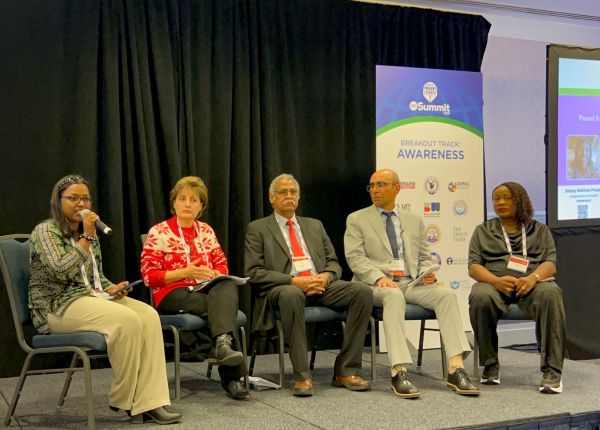
Funke Adeoye (right) attending a panel discussion at the 2026 IRF Summit in Washington D.C., where she addressed the need for decisive action against perpetrators of religious persecution, highlighting the complicity of the Nigerian government and justice system. Photo courtesy: Laura Kelly, The Hill.
In Nigeria, pre-trial detention continues to dominate prison populations, often driven by gaps in legal access and slow-moving courts. Funke Adeoye, founder of Hope Behind Bars Africa, explains how her organisation is working to expand representation, reduce detention, and push systemic reform.
Bonface Orucho, bird story agency
Pre-trial detention is one of the most persistent issues in Africa’s judicial system. Globally, the scale of pretrial detention continues to rise. More than three million people are currently held without conviction across 218 countries, according to the Institute for Crime and Justice Policy Research. These are individuals who have been detained through judicial or legal processes but have not been sentenced, many of whom have been held for months or years as cases move slowly through overstretched systems.
Africa sits at the sharp edge of this crisis. In about half of all countries on the continent, more than 40% of the prison population consists of pre-trial detainees. In some cases, that share rises to 70% or more, placing countries such as Mali, Gabon, and the Democratic Republic of the Congo among the highest globally for pretrial detention ratios.
The trend is not static. Since 2000, the number of pretrial detainees worldwide has grown by nearly 40%, outpacing global population growth. While Africa’s increase has been comparatively slower, rising by about 24% over the same period, the structural pressures remain acute, driven by weak legal aid systems, court backlogs, and limited access to representation.
Yet there are signs of change, and they are increasingly data-backed.
In Nigeria, recent joint findings by the United Nations Office on Drugs and Crime and the National Human Rights Commission show that 66% of inmates in custodial centers are still in pre-trial detention, but this marks a gradual decline from 70% a year earlier.
Elsewhere on the continent, governments are beginning to test structural reforms. Morocco has introduced sweeping changes to its criminal procedure code, including stricter limits on the use of pretrial detention, expanded access to legal representation, and the introduction of alternatives to imprisonment aimed at reducing overcrowding and accelerating case resolution. These reforms are part of a broader push to modernise justice systems while reinforcing rule-of-law commitments.
Taken together, these developments point to a system under pressure, but also one in transition.
A new cohort of legal advocates, civil society organisations, and reform-minded institutions is working to shift pretrial detention from a default practice to a last resort. Their efforts combine direct legal intervention with policy advocacy, institutional partnerships, and rights-based approaches to detention.
In Nigeria, that work is being led in part by Hope Behind Bars Africa, the organisation founded by lawyer and human rights advocate Funke Adeoye. Through pro bono legal services, prison advocacy, rights education, and institutional engagement, the organisation says it has supported more than 12,700 indigent incarcerated people, directly represented more than 3,400 pretrial detainees, and reached more than 45,000 people with preventive messaging. It has also engaged more than 14 security and justice institutions, helped shape policy reforms, and built partnerships across the justice sector.
In this conversation, she reflects on the realities behind the data.
This interview has been edited for length.
Before founding Hope Behind Bars Africa, what first exposed you to the scale of wrongful detention in Nigeria? Was there a defining moment?
My first exposure was actually personal. As a child, my father was incarcerated for an offense he did not commit, and it had a devastating impact on my family. He lost his job after he was released, and at some point, I had to stay out of school because we could no longer afford the fees.
I remember him saying that he was only able to regain his freedom because a lawyer helped him. That stayed with me. I ended up studying law, although at the time I did not fully connect it to that experience.
It was later, during my final year at university, when I began studying prison reforms and saw the data, that it all came back. I saw that around 65 percent of people in prison in Nigeria were awaiting trial, many simply because they lacked access to legal representation. That was the moment the issue became impossible to ignore.
From your early experience, what are the main systemic drivers of pretrial detention in Nigeria?
The biggest issue is lack of access to legal representation. Justice, in principle, should be accessible to everyone, but in reality it is often determined by wealth, power, or connections.
If you do not have the means to hire a lawyer, or the influence to navigate the system, you can remain in detention for years without trial. It becomes less about whether you committed an offence and more about whether you can afford to defend yourself.
What gap were you trying to fill when you founded Hope Behind Bars Africa?
The core goal was to bridge that gap in access to justice.
We wanted to ensure that anyone, regardless of their background or financial status, has a fair day in court. Access to legal representation is not just a constitutional right, it is a human right, but for many people it simply does not exist in practice.
That was the starting point for the organisation.
Was there a particular case that shaped your decision to fully commit to this work?
Yes, there was a case involving 20 men who had been arrested for murder and pipeline vandalism. When we looked into it, we realised these were young men who had simply been picked up off the streets. Some of them had never met each other before being charged with conspiracy.
We worked on the case through the courts and eventually secured their release. That experience changed how I saw the legal profession.
It made me realise that, just like doctors save lives, lawyers can also be lifesavers. That was when I knew I needed to do more than private practice. I resigned and began providing pro bono services, which led to the founding of Hope Behind Bars Africa in 2018.
Can you share one case that illustrates the human cost of prolonged pre-trial detention
One case that stays with me is Aisha, a young girl who was about 15 or 16 when I met her. She had been charged with homicide.
She had been married off at a very young age to a man three times her age and had experienced abuse. On one occasion when she tried to escape, her stepdaughter tragically fell into a well and died. She was immediately blamed, arrested, and detained.
Her age was even altered in official records so she could be held in prison. By the time I met her, she had spent three years awaiting trial without strong evidence linking her to the crime.
We were eventually able to secure her release, but the bigger question for me was not just the case itself. It was how a child ends up in that situation, denied education, forced into marriage, and then left without legal support when everything goes wrong.
From your work, who is most likely to remain stuck in pre-trial detention?
Poor people are the most vulnerable.
I have seen people remain in detention simply because they cannot meet bail conditions or find sureties. In some cases, individuals remain imprisoned over fines of less than one hundred dollars.
We also see journalists, activists and individuals who speak against powerful interests. The justice system can be used as a tool to silence them, with detention becoming a form of punishment before any trial takes place.
How has your work evolved beyond legal representation?
We quickly realised that legal representation alone is not enough.
When people are released, many return to the same conditions that led them into the system. Some even reoffend because prison, despite its conditions, offers basic survival, food and shelter.
So we expanded into rehabilitation and reintegration. We run programmes that train inmates in skills such as agriculture and vocational work, and we support income-generating activities inside correctional facilities.
At the same time, we work on policy reforms, especially around laws that criminalise poverty and status. We also advocate for non-custodial measures, because not every offence should lead to imprisonment.
Are you also leveraging technology in your work?
Yes, technology has become an important part of what we do.
We developed a legal support tool called JusticeBot AI, which allows people to access legal information and connect with lawyers, especially in urgent situations like arrests.
The idea is to reduce the barriers to accessing legal help, particularly for people who may not know their rights or cannot immediately reach a lawyer.
Do you see a broader continental movement around justice reform?
Absolutely. The challenges we face in Nigeria are not unique.
We work with networks such as the African Defenders Network and other access-to-justice coalitions across the continent. These collaborations allow us to share knowledge, mobilise resources, and support human rights defenders at risk.
There are also organisations across Africa doing important work in prison reform, including groups focused on women and vulnerable populations. These cross-border efforts are critical because the issues are systemic and widespread.
What reforms are most urgently needed to reduce prolonged pre-trial detention?
The key issue is not the absence of laws, it is the lack of implementation.
Nigeria has strong legal frameworks, but without political will, they do not translate into real change. We need commitment from leaders to enforce existing laws, invest in justice systems, and ensure accountability.
There are also deeper issues, including corruption and lack of judicial independence, which affect decisions like bail and prolong detention unnecessarily.
Looking ahead, what gives you hope about the future of justice reform in Africa?
I remain optimistic because of Africa’s young population.
We have a generation of young people who are increasingly aware of these issues and are willing to challenge them. Many are stepping into advocacy, legal reform, and public service.
If that energy is properly harnessed, it has the potential to reshape the justice system over time. For me, that is where the hope lies.
bird story agency
Leave a Reply