
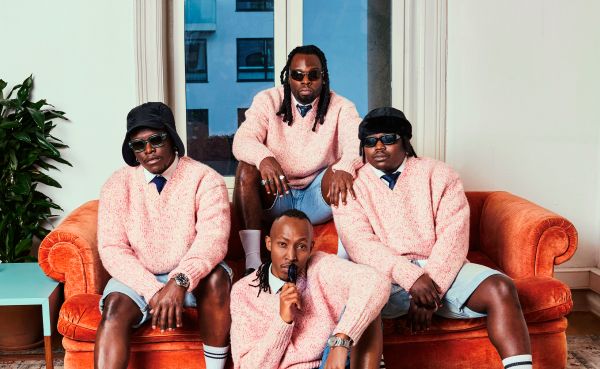
MATATA, a Kenyan-Norwegian Music and Dance, posing for a picture. Photo Courtesy: MATATA
A new generation of artists, audiences and organisers is redefining live performance and transforming festivals into global stages where African sound, identity and celebration is seeing massive growth, both locally and internationally.
By Conrad Onyango, bird story agency
At a music festival in Copenhagen, thousands of kilometres from Nairobi, Kenyan artist Elsy Wameyo found herself smiling as a familiar Luo greeting cut through the noise of the crowd and landed squarely on stage.
“I’ll never forget the day I played in Copenhagen and a fan greeted me in Luo,” the artist recalled. A greeting in the Kenyan vernacular was the last thing she had expected.
For Wameyo, a Kenyan-born singer-songwriter and rapper whose sound fuses hip hop, traditional African music, rap and R&B, the fact that “Nairobi showed up in northern Europe” is a reminder that African music from all over the continent is now travelling far and wide, its language, swagger and soul intact. And thanks to social media, live streaming and tuned-in audiences, the impact of a single festival performance can often reverberate globally, the entertainment value of the festival experience not lost on audiences continents away.
“I feel festivals usually bring out very unique and bizarre experiences that you would never get at your regular local gig,” Wayemo said.
The artist, who appeared at Nairobi’s increasingly well known Blankets & Wine Kenyan Summer Edition 2025, has also appeared at other major international music festivals including Pitchfork and Lollapalooza.
Compared to a decade ago, she said, African music is reverberating louder and louder as international festivals grow bigger and more frequent, while attendence at a single festival can convert into hundreds of thousands of new fans for an artist.
“You get to share a stage with multiple artists who may have fans that could be interested in your music too,” Wameyo explained.
Wameyo released her debut album, Saint Sinner, in 2024. Her debut EP, Nilotic (2022), a self-produced project, won six awards at the South Australia Music Awards and positioned her as one of the most compelling voices of her generation. Saint Sinner explores themes of self-empowerment and creative ownership.
African festivals are becoming internationally important too. Blankets and Wine is now going into its 18th year and sits alongside a growing roster of lifestyle, genre and culture-driven festivals, are drawing crowds hungry for live music in an increasingly crowded calender that in Kenya alone includes Mombasa Colour Festival, Underneath the Baobabs and Piny Luo (Luo Nation).
Across the continent, stages are filling with afrobeat, gengetone, amapiano, benga, house, hip-hop and soul, in a showcase of how African festivals have grown from occasional highlights to fixtures of the cultural economy.
“What they’ve (event organisers) done well is staying rooted. Despite international production standards and global line-ups, the language, rhythm, and stories remain African. You’ll still hear Swahili, Sheng and many other languages on stage,” said Freddy Milanya, a member of the group Matata.
Matata, is a Kenyan-Norwegian music and dance collective formed in 2016, emerging from Nairobi’s street culture before its members reconnected in Oslo, where they were pursuing further education.
Matata’s music is delivered in Swahili and in Kenya’s street slang, Sheng, driven by gengetone, afrobeat and a street-dance energy that has turned them into one of Kenya’s most recognisable exports.
Their debut single Denge (2019) marked the start of their steady rise, followed by viral hits such as Inakubalika and Mpishi, the latter featuring Sauti Sol’s Bien and surpassing seven million YouTube views in two months.
More recently, tracks like Tuma Madoo (“Send Money”) that tackle social themes such as “Black Tax”, have grounded their sound in lived African realities across the continent and diaspora.
Apart from Elsy Wameyo and Matata, the Kenyan Summer 2025 edition of Blankets & Wine put on stage some of the continent’s most recognisable and emerging voices, underscoring the festival’s reputation for cross-genre curation and regional balance.
Kenya’s Iyanii, Okello Max, Ssaru, Bridget Blue and Shad Mziki anchored the local lineup, delivering a mix spanning Afro-fusion, gengetone, soul, rhythm and blues (R&B), rap-dance and contemporary African pop. Tanzania’s Marioo, a chart-topping Bongo Flava star best known for his cross-border hit Nairobi, and UK artist Donae’o, fused London’s club energy to Nairobi with his tracks ‘Party Hard’ and ‘I’m Fly.’
Also featured were South Africa’s Scorpion Kings (Kabza De Small and DJ Maphorisa), widely regarded as pioneers of Amapiano, a South African-born genre that blends deep house, jazz-influenced piano melodies and township rhythms. Amapiano is one of Africa’s most successful global exports. South Africa’s Mi Casa, known for its signature fusion of house, jazz and soul, rounded off the continent-spanning lineup, reinforcing the festival’s 2025 theme, “Come We Dance!” These are sounds that dominate urban African playlists and most festival stages today.
Long before festival culture became mainstream in the region, organisers said the platform positioned itself as a space for careful curation, artistic risk-taking and long-term investment in African talent.
“When we launched Blankets & Wine, the goal was to create a platform for alternative, compelling and world-class African artistry. There weren’t many festivals that celebrated this vision in Nairobi or across East Africa,” said Muthoni the Drummer Queen, the festival’s founder and Creative Director.
The Kenyan singer, rapper and drummer whose sound blends hip-hop, reggae, dancehall, neo-pop and soul, anchored by drum patterns drawn from traditional Kenyan music, has seen the festival grow alongside Africa’s expanding live music ecosystem. She said the most significant change over the years has been the professionalisation and scale of festival production.
“What used to be small, localised events have grown into multi-layered productions requiring careful planning, infrastructure and strategic partnerships,” she said.
Today, Blankets & Wine features two distinct stages. There is the main performance stage and Onja Onja, a curated lifestyle space showcasing Kenyan food, fashion, art and creative brands, transforming the festival into a platform for live performance, commerce and cultural expression.
Sponsorship, Muthoni noted, has become central to modern festivals, as digital platforms and social media play a key role in audience engagement, marketing and storytelling. That evolution, she said, requires organisers to strike a careful balance between growth and creative integrity.
“Balancing these aspects is about staying true to the original vision while growing responsibly,” she said.
With Blankets & Wine now staged across Kenya, Uganda and Rwanda. Muthoni has expanded her footprint in the creative sector to include Africa Nouveau Festival and perFORM Music Incubator, initiatives designed to professionalise Africa’s music industry by building skills, infrastructure and sustainable career pathways for artists and industry practitioners.
Africa’s live music economy is rebounding strongly, with revenues now surpassing pre-pandemic levels, according to the PwC Africa Entertainment and Media Outlook 2025–2029.
The report shows that growth in live performance is being led by South Africa, which recorded US$76 million in ticket sales in 2024 and is projected to grow at a 5.9 % compound annual growth rate (CAGR). Kenya, while smaller in market size, posted US$1 million in live music revenues with a 2.1% CAGR, while Nigeria is projected to grow at 1.8 % annually.
“Kenya and Nigeria are stepping up their investment in live music and festival culture, driven by expanding middle-class populations and a growing appetite for regional genres,” said the PwC report.
Africa’s live entertainment economy is being reshaped by widespread digital access, heavy use of social media promotion, mobile payment systems, and the growing integration of streaming platforms into live events.
While Nigeria’s growth potential, PwC notes, is undercut by infrastructure bottlenecks, even as its large population continues to drive demand,
South Africa benefits from mature venues, high-end production capacity, and deep integration into international festival circuits, including globally recognised events such as Ultra South Africa and Rocking the Daisies.
The potential for more growth, from Cape Town to Cairo, is firmly on everybody’s radar.
bird story agency
Leave a Reply