
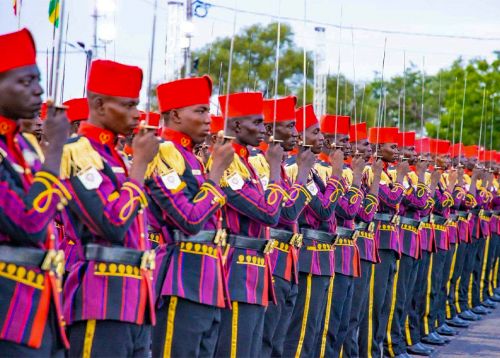
Officer cadets from the 25th class of the Georges Namoano Military Academy wearing parade uniforms made from traditional cencingu cloth during their graduation ceremony in Pô, Burkina Faso, on 25 July 2026. Photo: Presidency of Burkina Faso
By introducing traditional fabrics into school, judicial and military uniforms, as well as some public-service attire, Burkina Faso is seeking to create a sustainable market for locally processed cotton. The policy could support spinning mills, women weavers and garment workshops, provided the sector can meet the required volumes, prices and deadlines.
By Raphaël N. Aspavati, bird story agency
14 September 2026
In a small workshop equipped with two looms in the Taabtenga neighbourhood of Ouagadougou, Véronique Thiombiano Yonli and her colleagues are working hard to finish a length of cloth due the following day.
It is cencingu, also known as Tchintchingou in French, a fabric of Gourmantché origin deeply rooted in the traditions of eastern Burkina Faso.
The fabric gained national prominence when the government selected it for the parade uniform worn on 25 July 2026 at the graduation ceremony for the 25th class of active-duty officer cadets from the Georges Namoano Military Academy in Pô, about 140 kilometres from Ouagadougou.
Behind the cultural significance of the uniform lies a broader economic objective. By expanding the use of traditional fabrics, particularly Faso Dan Fani, across the public service and in schools, courts and the military, the state is stimulating demand for textiles produced in the country. The orders could support spinning mills, dyers, women weavers and garment workshops, while retaining more of the value generated by Burkina Faso’s cotton within the country.
**
The state creates a market for local fabrics**
Since Captain Ibrahim Traoré came to power in 2022, the government has introduced a series of measures to promote Burkinabè fabrics. Following a national forum on Faso Dan Fani in May 2023, a decree adopted the next month encouraged the wearing and use of Faso Dan Fani, Koko Dunda and other traditional fabrics in the public service, at official ceremonies and in the decoration of public buildings.
The measure was subsequently extended to schools. During a pilot phase in the 2025–2026 school year, pupils in four municipalities wore Faso Dan Fani or Koko Dunda uniforms twice a week. The government said the trial was not compulsory but plans to roll out the policy more widely from the start of the 2026–2027 school year. The details have yet to be specified.
In October 2024, Faso Dan Fani also became the courtroom attire of magistrates and court clerks. Orders from the defence and security forces and other public institutions have added to this demand. Together, these decisions are gradually turning uniforms and official attire into markets for local textiles.
The challenge of producing parade uniforms
Abdoul Ben Isaac Compaoré, a garment engineer and founder of the Black brand, made the officer cadets’ parade uniforms. The order tested his workshop. “We had to make 252 suits in four weeks,” he says, describing it as “a suicide mission that we had to pull off — and we did.”
According to Compaoré, the made-to-measure suits were produced through an entirely Burkinabè supply chain. “The yarn comes from FILSAH. The fabrics were produced by women weavers I brought in from different places, the other accessories were also made locally, and I contributed the design,” he says.
For producers, the appeal of this market lies in both its volume and its regularity. Its impact, however, depends on how contracts are awarded and whether local-content requirements are enforced. If the yarn or fabric is imported, a significant share of the value still escapes the national economy.
Tailor Soumanou Kiéma believes the state should also organise trade fairs to raise awareness of Faso Dan Fani. “Public orders must be more regular,” he says.
He also calls for stronger training for women weavers to ensure the quality of the fabrics.
**
FILSAH seeks markets for its yarn**
The local-uniform policy comes as Burkina Faso seeks to process more of its cotton domestically. Based in Bobo-Dioulasso, the Filature du Sahel, or FILSAH, is experiencing renewed activity after several difficult years.
The company, representing an investment of 18.5 billion CFA francs (US$32.7 million), turns cotton fibre into yarn supplied mainly to women weavers and producers of traditional cloth. At an open day on 30 April 2026, managing director Abdoulaye Nabolé announced an annual capacity of 10,000 tonnes of yarn and about 550 direct jobs, figures confirmed by the Ministry of Commerce.
According to Nabolé, the cotton-textile value chain “accounts for more than 10% of gross domestic product and supports more than 3.5 million people”.
But production capacity does not guarantee a market. FILSAH says fraudulent imports of yarn and cloth weakened its operations, contributing to unsold stock worth as much as three billion CFA francs (US$5.3 million). In 2026, enforcement agencies announced the seizure of fraudulent or illegally imported textile products valued at several hundred million CFA francs.
Public procurement could therefore support yarn manufactured by FILSAH. Its effect will nevertheless depend on the company’s ability to deliver the required quantities at competitive prices and within the prescribed deadlines.
Demand reaches the workshops
For some women weavers, the effects are already visible. Thiombiano Yonli says the promotion of traditional cloth has revived her business. “I have never seen my workshop this busy since I started this trade in 2020,” she says.
With only two looms, she sometimes manages “to weave as many as two lengths of cloth a day”. She received orders from schools at the start of the 2025–2026 school year and hopes the demand will continue.
Her prices vary according to the weight of the fabric, the yarn and the dye. “My cloth costs between 4,000 and 8,000 CFA francs, taking the economic situation into account so that I can keep my customers,” she explains. She says she no longer uses imported yarn: “With the state’s commitment to promoting traditional cloth, I now source 100% Burkinabè yarn from FILSAH.”
Her experience illustrates the intended mechanism: a school order provides work for the workshop and, further up the supply chain, creates demand for locally produced yarn.
In Loumbila, Alizèta Ouoba Nikiéma runs the Faso Impact training centre with her husband. She estimates that its turnover reached about 10 million CFA francs (US$17,700) over the past year, compared with approximately five million CFA francs two years earlier. She attributes the growth to the promotion of traditional fabrics, as well as to the rigour of their work.
“At Faso Impact, we weave all kinds of traditional cloth, including Faso Dan Fani, cencingu, Mandili and many others,” she explains. The work also requires mastery of dyeing because FILSAH’s yarn is sold white.
The National Federation of Women Weavers of Burkina Faso, FENATI/BF, has delivered 1,200 lengths of cloth worth 12 million CFA francs (US$21,200). In a report presented on 8 May 2026, it also cited its contribution to the production of Faso Dan Fani school uniforms.
**
Production capacity put to the test**
Rising demand creates opportunities but also exposes the sector’s constraints. Thiombiano Yonli lacks the means to buy additional looms. At Faso Impact, cramped dormitories prevent the centre from accepting more trainees.
“My centre serves a social purpose. Most of the trainees have fled conflict zones or forced marriage,” says Nikiéma, who is calling for additional facilities.
The government is attempting to address some of these constraints by building the National Centre for the Support of Artisanal Cotton Processing, known as CNATAC. Built on a 10-hectare site, it is intended to bring together weaving, dyeing, cutting and sewing workshops, as well as training and exhibition spaces. The project could help artisans fulfil larger orders and meet common standards for quality and delivery times.
Progress remains uneven, however. In Fada N’Gourma and Ziniaré, Tanilemba Tankoano and Viviane Dayamba Bouda are still struggling to sell their cloth. Bouda sells only two pieces a week, earning an estimated profit of between 2,000 and 3,000 CFA francs (US$3.50–US$5.30). Her workshop, situated inside a large welding yard, has little visibility. She does not belong to an association and has no presence on social media.
Tankoano, meanwhile, did not consider weaving her main occupation until government policy encouraged her to invest more in it. The contrast with workshops receiving school orders shows that access to public contracts, equipment, finance, raw materials and commercial networks remains decisive.
From public procurement to industry
Alongside FILSAH and CNATAC, the government is developing TEXFORCES-BF, a textile complex intended to supply clothing to the defence and security forces as well as the wider population. It was inaugurated on 9 September.
These projects reflect the ambition to connect cotton production to spinning, weaving and, ultimately, the manufacture of finished garments. The challenge now is to turn uniform policies into sustainable, measurable orders that genuinely use Burkinabè cotton and yarn, while ensuring that small businesses and women weavers’ associations can access them.
For workshops such as Thiombiano Yonli’s, the initial effects are visible. But moving from a growing number of artisanal orders to a fully fledged textile industry will depend on Burkina Faso’s ability to organise the entire value chain, from cotton grown in its fields to uniforms worn in its schools and institutions.
bird story agency
Leave a Reply