
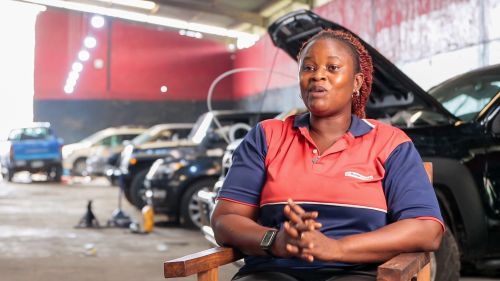
Tokunbo Adegoju during an interview with bird story agency at the Automedics workshop in Illepeju, Lagos, July 10, 2026. Photo: Dorcas Bello, bird story agency
Tokunbo Adegoju never intended to become a mechanic. Today, she is called on as an expert to diagnose vehicle defects, whether that’s through radio shows or in person.
By Dorcas Sheffy Bello, bird story agency
A caller’s Toyota had “developed a rattle, but only when it idles”. He could not explain it any better than that. He did not have to, however. On the other end of the line during the Auto Medics segment on Lagos Traffic Radio 96.1FM, Tokunbo Adegoju was already asking the questions that mattered.
“Does it happen on a cold start, or after you’ve been driving a while? Does it change when you rev the engine?”
Within minutes, she had narrowed the problem to a likely cause, advised the caller on what to check when he got home, and moved on to the next call. It was just another weekday radio show, another problem to successfully diagose.
An automotive technician by day at Auto Medics in Lagos, Adegoju has established herself as one of Nigeria’s few female senior automotive technicians. Through her radio programmes on Eko FM and Lagos Traffic Radio, she also helps motorists understand vehicle faults before they take their vehicles to a workshop.
None of this was in her original plan. Growing up, Adegoju believed she would become a doctor, largely because it was the future her grandfather had imagined for her.
“He would always say, oh, he will be a medical doctor. He bought me a stethoscope and this thing for blood pressure then, just to encourage me to be a medical doctor. So , despite all those things that I do at home, I still had it in mind that I want to study medicine.”
Long before she considered repairing cars, Adegoju had developed a habit of fixing things around the house. Looking back, she believes her father recognised that curiosity before she did. Whenever the family’s generator broke down or something needed repairing, he would call her to work alongside her brothers. At the time, she simply thought she was spending time with them.
“I just saw it as working with my brothers,” she recalled. “But I think he’d seen something in me, and that’s why he kept encouraging it.”
At boarding school, that curiosity only grew. She repaired wall sockets, switches, lamp holders and light bulbs simply because she enjoyed understanding how they worked. Cars were never part of the picture. The closest she came to automotive repairs was helping her father change a flat tyre alongside her younger brother.
Her mother worried whenever she worked around live electrical wires. Seeing sparks fly, she would ask her to stay away, believing those jobs were not meant for girls. Her father always responded the same way.
“She’s interested. Let her.”
Medicine remained her focus until a road accident changed those plans. While travelling for a pre-degree programme, she was involved in a crash that forced her to reconsider the career she had been preparing for. The experience left a lasting impression.
“The sight of blood, I… I was shivering, and I was like, “Oh, I don’t think it’s for me.”
She decided to pursue a different path.
“But I got to realize that if I’m not a doctor of humans, I can be a doctor for other things.”
Years later, her husband encouraged her to consider automotive repair as a profession.
“He heard somebody talking on radio, the radio program I run now, and he was like, “Oh, this thing, this person is doing it, but you can do it better. I believe you can do it better. Why don’t you go for the training?”
That decision led her to Auto Medics.
Engineer Kunle Shonaike, the founder of Auto Medics, has spent years teaching mechanics and advocating for more women to enter the field. Drawing on his experience, he claims that the barriers women confront frequently extend beyond the workshop.
“Cultural attitude has a lot. Cultural barrier has a lot to do with women not well represented in the automotive field, but I believe it’s changing.”
Shonaike believes that improving vocational skills is critical to boosting Nigeria’s workforce. He believes that skilled artisans are crucial to the country’s economy because they supply the practical competence required to develop, maintain, and repair critical infrastructure and equipment.
“Vocational jobs or experience is very vital to any economy, not just to the Nigerian economy… They are the builders of the economy because they are the ones that actually build and repair.”
Training at Auto Medics introduced Adegoju to a different kind of test. Before she was trusted to diagnose faults, she was expected to prove she could handle the physical demands of the job. She lifted vehicles, carried heavy tyres and learned to use hydraulic jacks after years of working only with screw jacks.
“They want to test your strength,” she says. “They make sure you understand this isn’t a job you’ve come to paint your nails for.”
Some technicians questioned whether she could even remove a tyre. She had been changing tyres with her father since she was a child, so the task was familiar. What she needed to learn was how to work in a professional workshop.
Today, she is one of the senior technicians at Auto Medics and is helping train the next generation of mechanics, including young women entering a field where female mentors remain uncommon.
Adegoju’s work comes as Nigeria expands technical and vocational education to provide employment options for young people, women, and people with disabilities. According to the International Labour Organization, the country’s ongoing skills reforms seek to enhance access to technical training that can lead to decent employment, particularly in fields where women are underrepresented. Adegoju’s training of young mechanics is part of a larger push to boost female participation in technical careers.
Johnny Onyeka Justin, one of her trainees, calls her “Workshop Mom.”
“She’s the first woman I’ve seen in this field who moves like that with real action,” the trainee said. “You’re scared of her at first. Then you realise underneath it she just wants the best for you.”
Justin remembered breaking down on the roadside and calling Adegoju after noticing an unusual smell coming from the engine. Before the car was taken to the workshop, Adegoju had already identified the likely problem over the phone.
There were times when the trainee considered leaving the profession, but Adegoju urged him to continue.
“Look at me now. I’m diagnosing; I’m fixing cars. If I’d given up, I wouldn’t be here,” Adegoju said.
“I call her my second mum. My Workshop Mom.”
Efforts to encourage more women to pursue technical occupations are gaining traction across Africa. In Ghana,between 2013 and 2019, an African Development Bank-supported technical and vocational education project provided scholarships to 4,510 students and apprentices, more than half of whom were women, to help expand access to skills training in fields such as mechanical engineering and other traditionally male-dominated trades. Across the continent, efforts like these are paving the road for more women to enter technical professions, while mentors like Adegoju help them succeed once they do.
Senior technician Ibrahim Ogundele said Adegoju’s presence in the workshop has helped change how some women view automotive repair.
“There are women who never imagined another woman could repair a car. Seeing her do it becomes the motivation.”
Today, Adegoju divides her time between the workshop and the radio studio. On air, callers describe unfamiliar sounds, warning lights and engines that refuse to start. She listens, asks a series of questions, and helps them understand what might be wrong before they visit a mechanic.
For Adegoju, it is another way of doing what she set out to do years ago: solving problems, one diagnosis at a time.
bird story agency
Leave a Reply