
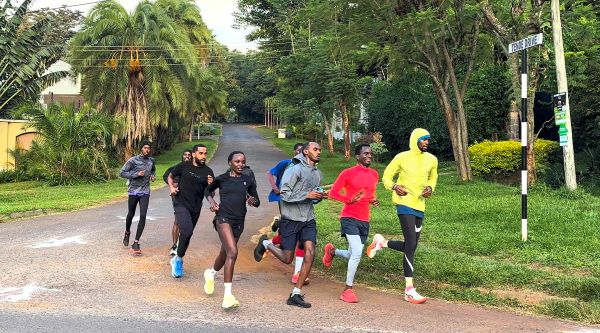
We Run Nairobi participants taking part in a morning run aimed at promoting athletic lifestyles in Nairobi, Kenya on April 4, 2026. Photo: Stacey Kakea, bird story agency.
A Nairobi lawyer started a free running club to get a few friends moving on Saturday mornings. Three years later, We Run Nairobi has become the city’s largest free running community, with a global brand partnership and requests to expand across Kenya.
Stacey Kakea, bird story agency
13 May 2026
The parking lot at Nairobi’s KOFISI Square fills up well before 7:30 on a Saturday morning. Gone are the hangover sunglasses and bleary faces suggesting a big Friday night out. The people stretching against the curb, adjusting their running watches, or just standing and chatting as the sun rises look fresh-faced and eager.
Something has been changing here.
Emily Chepkor is a lawyer and an 11-time marathoner. In October 2022, she was also the person who convinced three friends to join her for a Saturday morning run.
“Nairobi is a party city, a feel-good city. We wait for Friday,” she says. “But now we’re changing the culture. People are sacrificing their Friday nights, or shifting them, because they want to rise early and run.”
What started with four people jogging on the pavement has grown into We Run Nairobi, now the largest free running community in the city, drawing hundreds of people to its Saturday sessions at Riverside Square every week.
A growing trend towards improved health awareness in Kenya is not limited to running. Cycling, skating, hiking and other activities have become popular in light of a deepening health crisis in urban Kenya. According to WHO Kenya’s 2025 annual report, NCDs account for 41 per cent of all deaths and half of all hospital admissions in the country.
At Kenya’s inaugural National NCD Conference in Nairobi in November 2025, Dr. Ouma Oluga, Principal Secretary for Medical Services, described the issue as one of the country’s most pressing public health challenges and called the conference a milestone moment in addressing it.
For many participants, We Run Nairobi has become an alternative to fitness spaces that often feel inaccessible.
Gorgina Atieno had spent years knowing she needed to get fit but struggling to commit to a gym routine.
“The gym felt like a chore,” she says. “It’s expensive, crowded, and intimidating.”
What she found instead at We Run Nairobi was a free outdoor community where people consistently showed up every week, not just to run, but to encourage one another.
Hundreds of runners now fill Nairobi’s streets on Saturday mornings, many carrying similar stories of wanting movement without the pressure often attached to traditional fitness culture.
The accessibility is part of what sets the club apart. While other running groups charge Ksh 600-1,800 for runs and to cover a post-run meal, We Run Nairobi charges nothing.
Malia, a law student following the 75 Hard fitness programme, discovered the club through Instagram and decided to join.
“I love the community and seeing people together being healthy,” she says. “It’s all really intentional. The specific warm-up times, the distances, the cool-down. For me, exercising outdoors was a requirement for my journey, and this community spoke to me personally.”
The run itself is only part of the experience. After the routes end, many participants stay behind to eat, socialise, and build friendships. Malia says that is where much of the real networking happens.
“It’s optional,” she adds. “Yet we’re all here.”
The club’s visibility has now stretched far beyond Nairobi’s running circles. Chepkor is currently a brand ambassador for the Swiss running company On, and the club recently co-hosted a lifestyle run at Windsor Golf Club that attracted more than 500 people.
That a global sportswear company came to Nairobi looking for a running club started by a lawyer and three friends says something about how quickly the movement has grown.
Alfredo St. Forbes, a lead coach with a degree in health science and certification from the National Academy of Sports Medicine (NASM), says the cultural shift is becoming visible beyond fitness itself.
“A few months ago, even the alcohol industry was complaining that they’re not getting as much revenue,” he says. “Gen Zs and millennials are starting to pick up what it means to be athletic as a lifestyle. Kenya is becoming an athletic nation.”
Behind the growth of We Run Nairobi, however, was a much more personal struggle.
Before WRN existed, Chepkor had been navigating one of the hardest periods of her professional life. After working in public international law, she made the difficult decision to transition into traditional legal practice, a move that effectively required her to start over.
“You’re starting from the very bottom once again. You’re taking a cut in everything,” she says. “There’s a dissonance with where you’re at, where you should be, where your peers are.”
That uncertainty lasted for nearly three years. Through it all, running became the one constant she refused to lose.
“When something else is failing, you hold on so dearly to the one thing that you have control over.”
Building We Run Nairobi also came with financial strain. Organising weekly events at scale across neighbourhoods that participants travel long distances to reach required money, time, and consistency. For a long period, Chepkor was funding much of it herself.
“It couldn’t continue being a role that takes up all of your time for free,” she says. “So it had to make a business case for itself so that it can move on to the next person.”
Today, corporate partnerships help sustain the operations behind the scenes, though Chepkor is realistic about how long it took to get there.
“It has taken on a sustainable angle a little way later than when it started,” she says. “Which I guess is just the case for anything that starts up.”
The idea is now spreading beyond Nairobi. Communities from other parts of Kenya have started reaching out, asking whether the model can be replicated in their towns and cities.
“We get enough requests to replicate it in different parts of the country,” she says. “But at the core of that is always sustainability, because they always have to be free.”
Most Saturdays, the run ends with a DJ set. By 10:00 AM, the parking lot has transformed into a dance floor filled with runners still catching their breath, laughing, talking, and moving together in broad daylight.
“We’re all sober, dancing, and joyous in association with movement,” Chepkor says. “It proves that we are a ‘good time’ continent. But that joy doesn’t have to be tied to the night.”
Chepkor has effectively turned Nairobi’s streets into a public gym that anyone can join. In a city where access to public parks and recreational spaces remains limited, that accessibility matters.
When the warm-down session finishes at KOFISI Square, people do not rush home immediately. They stay behind for coffee, conversations, and discussions about the route, the hills, and which parts of the run hurt the most.
Nairobi once came alive mainly after dark. Chepkor is making the case for the other end of the day.
bird story agency
Leave a Reply